Quick answer: The JST ACH is a 1.2mm pitch, single-row, disconnectable crimp-style wire-to-board connector with a height of 1.4mm and a width of 4.3mm, available in 1 to 5 circuits. Its current rating is circuit-count dependent: 2A AC/DC for 1 to 3 circuits and 1.5A AC/DC for 4 and 5 circuits, both quoted with AWG #28 wire. It is rated 50V AC/DC, operates from −25°C to +85°C, and accepts AWG #32 to #28 with an insulation outside diameter of 0.38 to 0.63mm. Contact resistance is 10mΩ max initial, 20mΩ max after environmental tests; insulation resistance is 100MΩ min; dielectric withstanding voltage is 500 VAC per minute. Its defining construction is top entry but side feed — the socket mates onto the header from the vertical direction while the wires exit horizontally. JST states the series was originally designed for a DC power supply application. The KONNRA KR1201 series is documented as the cross-reference equivalent.
At a glance
| Series | JST ACH — also written ACH1.2 |
| Pitch | 1.2mm |
| Configuration | Single row, wire-to-board, disconnectable crimp style |
| Height × width | 1.4mm × 4.3mm |
| Circuits | 1 to 5 |
| Current rating | 2A (1–3 circuits) · 1.5A (4–5 circuits), at AWG #28 |
| Voltage rating | 50V AC/DC |
| Operating temperature | −25°C to +85°C (including temperature rise under load) |
| Applicable wire | AWG #32 to #28 |
| Insulation O.D. | 0.38 to 0.63mm |
| Contact resistance | 10mΩ max initial · 20mΩ max after environmental tests |
| Insulation resistance | 100MΩ min |
| Withstanding voltage | 500 VAC / minute |
| Mating construction | Top entry, side feed — socket mates vertically, wires exit horizontally |
| Assembly feature | Suction area on the inside bottom of the header for pick-and-place nozzles |
| Housing material | PBT, UL94V-0, natural (white) |
| Contact material | Copper alloy, nickel-undercoated, gold-plated |
| Standards | UL Recognized E60389 · CSA Certified LR20812 · RoHS compliant |
| KONNRA equivalent | KR1201 |
What Is the JST ACH Connector?
The ACH is the connector you reach for when you need 2 amps through a 1.2mm pitch. That combination is unusual — most 1.2mm and 1.25mm board connectors are rated between 1A and 1.5A — and it exists because JST designed the series for a specific purpose rather than as a general-purpose signal connector.
JST’s own description is direct: the ACH Series Wire to Board connector “was originally designed for a DC power supply application and has a 2.0 Amp current rating for both the 2 and 3 circuits, using wire size 28 AWG.”
The second distinguishing feature is geometric. JST calls it “top entry but side feed”: the socket half mates with the header from the vertical direction, while the wires come out from the horizontal direction of the socket. That is not a marketing detail — it is the reason the connector solves a problem that a conventional vertical wire exit cannot.
Key characteristics:
- 1.2mm pitch, single row, 1 to 5 circuits
- 1.4mm height, 4.3mm width — a low-profile body for tight enclosures
- 2A at 1–3 circuits, 1.5A at 4–5 circuits, both at AWG #28
- 50V AC/DC rating
- Top entry but side feed — vertical mating with a horizontal wire exit
- DC power supply heritage — the series was designed for power, not just signals
- Pick-and-place compatible — a suction area on the bottom of the inside header gives an automated nozzle somewhere to sit
- Disconnectable crimp style — the socket housing can be unplugged from the header for service
- UL Recognized and CSA Certified
- Two crimp contacts split by wire gauge, so the series covers the full AWG #32–#28 window with two parts rather than one compromise contact
A short glossary, because this series uses specific terms
- Socket / housing — the wire-side half. JST’s ACH socket part numbers follow the
ACHR-…V-Spattern. It mates onto the header and holds the crimp contacts. - Header / wafer — the board-mounted half. JST’s ACH headers use the
BM…B-ACHSS-GAN-TFpattern, supplied on embossed tape for automated placement. - Top entry — the socket comes down onto the header from above the board.
- Side feed — the wires leave the socket horizontally. Top entry plus side feed is the combination that defines this series.
- Disconnectable — the mated pair can be separated and re-mated, as opposed to a permanent (IDC or soldered) termination.
- Crimp contact — the metal contact crimped onto the wire before insertion into the socket. The ACH uses two, split by conductor size.
- Insulation O.D. — the outside diameter of the wire’s insulation jacket. On a 1.2mm-pitch connector the crimp barrel must match both the conductor and this dimension.
- Suction area — a flat pad on the bottom of the inside header sized for a pick-and-place nozzle. Its presence is why this connector can be placed by machine rather than by hand.
- AWG #28 — the gauge at which JST quotes the ACH current ratings. Other gauges inside the series window carry different limits.
JST ACH 1.2 and KONNRA KR1201 Specifications
| Parameter | JST ACH (JST documentation) | KONNRA KR1201 (KONNRA documentation) |
|---|---|---|
| Pitch | 1.2mm | 1.20mm |
| Row configuration | Single row | Single row |
| Connection type | Wire-to-Board | Wire-to-Board |
| Termination | Crimp (disconnectable) | Crimp |
| Height × width | 1.4mm × 4.3mm | 1.4mm × 4.3mm |
| Circuits | 1 to 5 | 2 ~ 7P |
| Current rating | 2A (1–3 circuits) · 1.5A (4–5 circuits), AWG #28 | 1.5A |
| Voltage rating | 50V AC/DC | 50V |
| Applicable wire | AWG #32 to #28 | AWG #28–#30 (1.2mm range) |
| Insulation O.D. | 0.38 to 0.63mm | 0.75mm max |
| Contact resistance | 10mΩ max initial · 20mΩ max after environmental tests | 20mΩ max |
| Insulation resistance | 100MΩ min. | 100MΩ min. |
| Withstanding voltage | 500 VAC / minute | 500V AC / minute |
| Operating temperature | −25°C to +85°C | −40°C to +105°C |
| Housing material | PBT, UL94V-0, natural (white) | PA66 / LCP / UL94 / Phosphor Bronze |
| Contact material and finish | Copper alloy, nickel-undercoated, gold-plated | Gold flash over nickel |
| Packaging | Embossed tape | Tape and reel (see package specification) |
| Standards | UL Recognized E60389 · CSA Certified LR20812 | RoHS compliant |
Where the two documents agree: the pitch, the single-row configuration, the 1.4mm × 4.3mm body, the 50V rating, the 100MΩ minimum insulation resistance, and — worth noting, given how often this row goes wrong — the 500 VAC per minute withstanding voltage.
Where they differ: the current rating, the available circuit counts, the applicable wire window, the contact resistance basis, the temperature range, the housing material, and the standard recognised by each side. Each one is covered below.
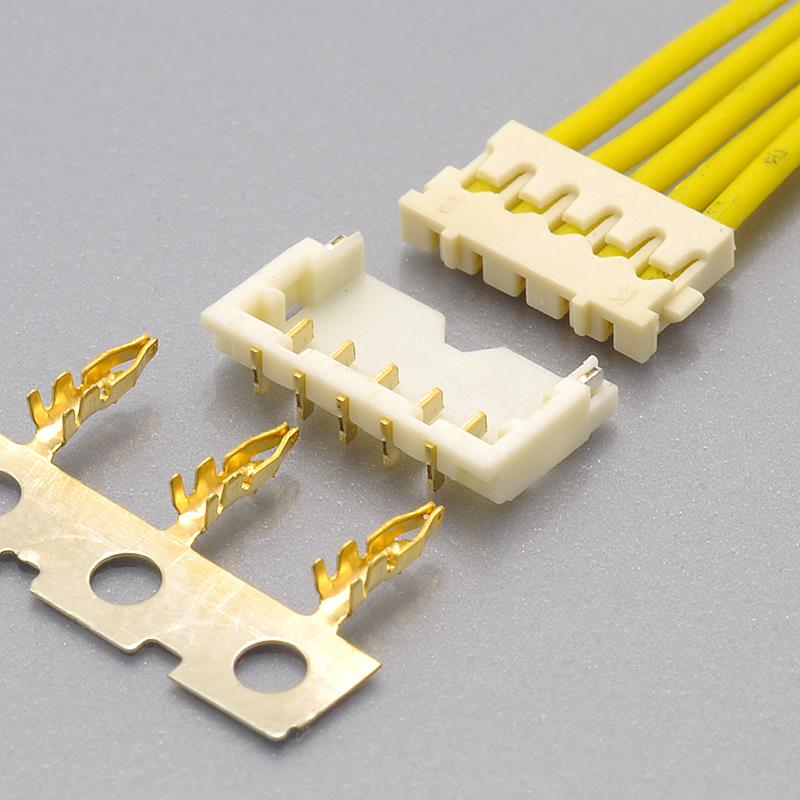
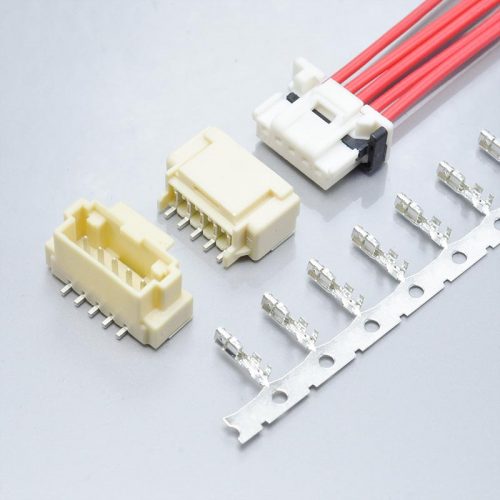
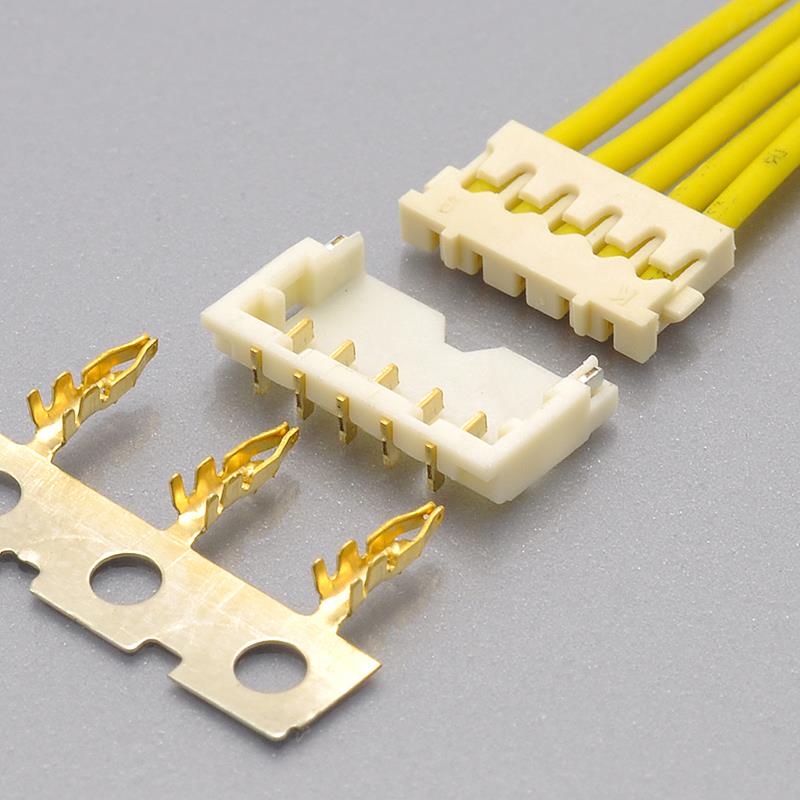
Figure 1 — KONNRA KR1201 series: 1.2mm pitch ACH wire-to-board connector
➡️ View the KONNRA KR1201 ACH 1.2 Connector
The 2A Rating Is Actually Two Ratings
The ACH’s headline number is 2 amps. It is also the number most often quoted incorrectly, because JST’s rating is circuit-count dependent.
| Circuits | Current rating (AWG #28) |
|---|---|
| 1 to 3 | 2A AC/DC |
| 4 to 5 | 1.5A AC/DC |
Why this matters in practice. If your design uses four or five circuits, the applicable rating is 1.5A, not 2A. A specification sheet or a distributor listing that quotes “2A” without the circuit count is quoting the 1–3 circuit figure, and a 5-circuit design built to it has no margin.
And the KONNRA side publishes a single figure. The KR1201 is documented at 1.5A flat — which is exactly JST’s 4–5 circuit number. That has two consequences, and they pull in opposite directions:
- For a 1–3 circuit design, the KONNRA documentation understates the original part’s capability by 25%. The JST ACH carries 2A on 1 to 3 circuits; if you need 2A and your design is 3 circuits or fewer, the original is rated for it and the published KR1201 figure is not a statement that the connector cannot do it — it is a statement of what has been documented.
- For a 4–5 circuit design, the figures match, and there is no derating question.
What to do about it: state your circuit count and your current on the enquiry. If you need 2A on 1 to 3 circuits, ask for the KR1201 rating to be confirmed against your circuit count in writing rather than assuming the flat figure is a hard ceiling.
The bigger point: 2A through a 1.2mm pitch is rare. Most connectors at this pitch — including Molex’s Pico-EZmate at 1.20mm and JST’s own SH at 1.00mm — are rated 1A to 1.5A. If your requirement is 2A and you have three circuits or fewer, the ACH is one of the few 1.2mm options that meets it without going up a pitch.
Top Entry, Side Feed: What the Construction Actually Buys You
JST describes the ACH as “top entry but side feed type”, and the sentence is worth unpacking because it is the reason this connector is specified rather than a lower-profile alternative.
- Top entry — the socket is mated with the header from the vertical direction. You do not need board-edge access and you do not slide anything sideways, so the connector can sit in the middle of a board.
- Side feed — the wires come out from the horizontal direction of the socket.
Together, those two facts mean the harness leaves parallel to the board. A conventional vertical wire exit adds the cable’s bend radius to the height of the assembly, which on a 1.4mm-tall connector defeats the point of choosing a 1.4mm-tall connector. With a side feed, the clearance problem moves from the vertical axis to the horizontal one — and on thin devices, horizontal clearance is usually the axis you have.
Three practical consequences:
- The 1.4mm body height is usable, not theoretical. The cable does not consume it.
- Strain relief can be anchored to the board. A horizontal run can be tied down within a few millimetres of the connector; a vertical run over a low connector usually cannot.
- The harness can be serviced without lifting it over the connector. Unmating is a vertical pull on the socket while the harness stays flat.
JST also builds in a pick-and-place feature that most 1.2mm connectors lack: “A sucking area on bottom of inside header is available.” The inside bottom of the header carries a flat suction pad sized for an automated nozzle, so the ACH can go through a standard SMT line rather than being hand-placed.
One thing to check on the drawing: the offset between the header’s board pattern and the socket’s wire exit direction defines which way the harness runs. On a layout with limited horizontal clearance, confirm the exit direction against your enclosure before you commit the footprint.
Circuit Counts and Body Dimensions
JST documents the ACH in 1, 2, 3, 4 and 5 circuits, and the body grows by exactly 1.2mm per circuit.
| Circuits | A dimension (mm) | B dimension (mm) |
|---|---|---|
| 1 | — | 1.6 |
| 2 | 1.2 | 2.6 |
| 3 | 2.4 | 3.8 |
| 4 | 3.6 | 5.0 |
| 5 | 4.8 | 6.2 |
The A dimension follows A = (circuits − 1) × 1.2mm, which is the cross-check to run against any drawing you are handed.
Two differences against the KONNRA documentation:
- KONNRA states 2 ~ 7P. JST documents the ACH in 1 to 5 circuits. That is up to two positions beyond the original’s range, and it also omits the single-circuit option that JST does offer. Confirm the exact count you intend to order rather than assuming the ranges are equivalent.
- The KONNRA range starts at 2. If your design is a 1-circuit ACH, the KR1201 documentation does not cover it.
➡️ Confirm availability for your exact circuit count
JST ACH = KONNRA KR1201: Part Number Cross-Reference
| JST ACH component | JST part number | KONNRA equivalent |
|---|---|---|
| Socket (wire housing) | ACHR-…V-S pattern |
KR1201 Housing |
| Header (board wafer) | BM…B-ACHSS-GAN-TF pattern, embossed tape |
KR1201 Right Angle Wafer |
| Crimp contact, AWG #30–#28 | SACH-003G-P0.2 — 0.05–0.08mm², insulation 0.5–0.63mm, 30,000 per reel | KR1201 Terminal |
| Crimp contact, AWG #32–#30 | SACH-003G-P0.2B — 0.032–0.05mm², insulation 0.38–0.5mm, 30,000 per reel | KR1201 Terminal |
| Crimp machine | MKS-L-10-3 · AP-K2N MKS-L-10-3 |
Not documented |
| Crimp applicator | MK/SACH-003-02 · APLMK SACH003-02 |
Not documented |
The three orderable components on the KONNRA side, each with its own page and drawing:
| Component | KONNRA page |
|---|---|
| Housing | KR1201 Housing |
| Right Angle Wafer | KR1201 Right Angle Wafer |
| Terminal | KR1201 Terminal |
Which crimp contact goes with which wire
JST splits the ACH’s wire window across two crimp contacts rather than one. Selecting the wrong one is the most common ACH harness error.
| Contact | Conductor size | Insulation O.D. | Use it for |
|---|---|---|---|
| SACH-003G-P0.2 | AWG #30 to #28 (0.05–0.08mm²) | 0.5 to 0.63mm | The default for AWG #28 and heavier insulation |
| SACH-003G-P0.2B | AWG #32 to #30 (0.032–0.05mm²) | 0.38 to 0.5mm | Fine wire at AWG #32 to #30 |
The overlap runs the opposite way from what most people assume. Both contacts cover AWG #30, so in the #30 band the conductor gauge does not decide between them — the insulation outside diameter does. Insulation of 0.5mm and above goes to the P0.2; below 0.5mm goes to the P0.2B. On a 1.2mm pitch, where the crimp barrel has very little room, that distinction is the difference between a reliable crimp and a rejected harness.
And the series figure is a union of the two. JST quotes the ACH as accepting AWG #32 to #28 with insulation of 0.38 to 0.63mm — which is exactly the two contacts’ windows joined together. If your BOM cites “AWG #32–28” without naming the contact, it has not yet specified the part.
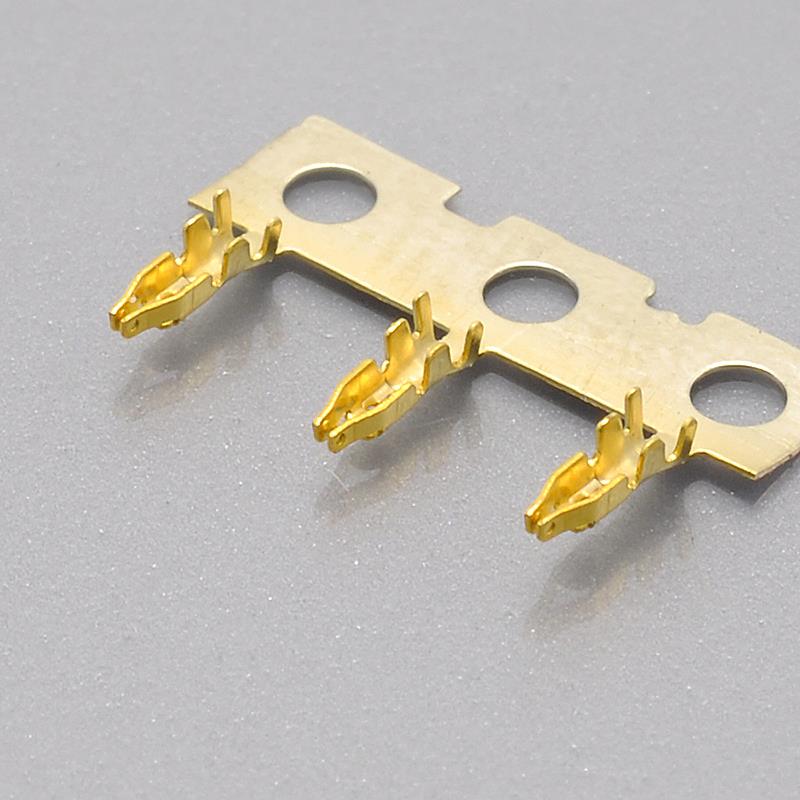
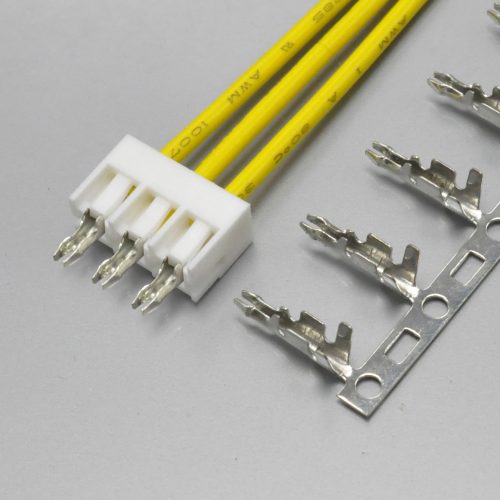
Figure 2 — KR1201 crimp terminal for the 1.2mm ACH interface
The wire-to-wire sibling
JST also publishes ACH documentation for a wire-to-wire version of the series, describing a disconnectable crimp-style wire-to-wire connector at the same 2A and 50V headline ratings. KONNRA’s published KR1201 covers the wire-to-board path. If your design uses the wire-to-wire ACH variant, say so in the enquiry rather than assuming the wire-to-board cross-reference covers it.
Specification Differences to Verify Before You Cross-Reference
Nine points deserve attention before you sign off an ACH cross-reference. Note that the withstanding voltage row is not one of them — both documents state 500 VAC per minute, and on this series that parameter lines up.
- The current rating is circuit-count dependent on the JST side and flat on the KONNRA side. JST: 2A for 1–3 circuits, 1.5A for 4–5 circuits, both at AWG #28. KONNRA: 1.5A. The flat figure equals JST’s 4–5 circuit number, so a 1–3 circuit design is being understated by 25% while a 4–5 circuit design matches. State your circuit count and current on the enquiry.
- Circuit counts: 1 to 5 on the JST side, 2 ~ 7P on the KONNRA side. Up to two positions beyond the original, and the single-circuit option that JST offers is not covered.
- The insulation outside diameter has a minimum on the JST side and none on the KONNRA side. JST specifies 0.38 to 0.63mm — a two-sided window split across two crimp contacts. KONNRA documents 0.75mm max and publishes no minimum. On a 1.2mm pitch the crimp barrel’s acceptable band matters in both directions: a wire below 0.38mm O.D. is outside JST’s specification, and the KR1201 documentation gives no lower bound at all. Ask for the minimum as well as the maximum, for the terminal you intend to order.
- Contact resistance is quoted on different bases. JST publishes 10mΩ max initial and 20mΩ max after environmental tests. KONNRA publishes 20mΩ max — which is JST’s after-environmental-test figure, not its initial value. This is not a case of KONNRA being looser: it is a different measurement basis. Compare the initial figures to the initial figures.
- Operating temperature. JST specifies −25°C to +85°C and states that this range includes the temperature rise caused by current flow — a stricter definition than a bare ambient range. KONNRA documents −40°C to +105°C. If you rely on operation above +85°C or below −25°C, ask for the supporting test data rather than taking the wider figure at face value.
- Housing material. JST specifies PBT, UL94V-0, natural (white). KONNRA documents PA66 / LCP. Those are different polymer families with different moisture absorption and dimensional behaviour. If your process window or your customer’s specification names a material, confirm equivalence.
- Standards. JST lists UL Recognized E60389 and CSA Certified LR20812. KONNRA’s product documentation states RoHS compliance, with UL certification asserted at brand level. If your qualification requires UL Recognized component status specifically for this part, ask for the file reference.
- Neither side states the gold thickness. This one is often misread as a difference, so it is worth being precise: JST describes the contact as “copper alloy, nickel-undercoated, gold-plated”; KONNRA describes it as “gold flash over nickel”. Both are gold over a nickel undercoat, in the same sequence. Neither document gives a thickness in microns. If your qualification specifies a gold layer thickness, ask for the figure — do not infer it from the word “flash”.
- Crimp tooling is documented by JST and not by KONNRA. JST publishes the crimp machine (
MKS-L-10-3,AP-K2N MKS-L-10-3) and the applicator (MK/SACH-003-02, withAPLMK SACH003-02as the applicator-with-dies option). KONNRA does not document tooling against the KR1201 terminal. If you crimp in-house, ask which applicator the terminal is validated against — on a 1.2mm pitch that question saves the most rework.
Components and Configuration Options
The KR1201 is specified as three separately orderable components, so the same series serves both connector-only and fully assembled orders.
Wafer (board-mounted header)
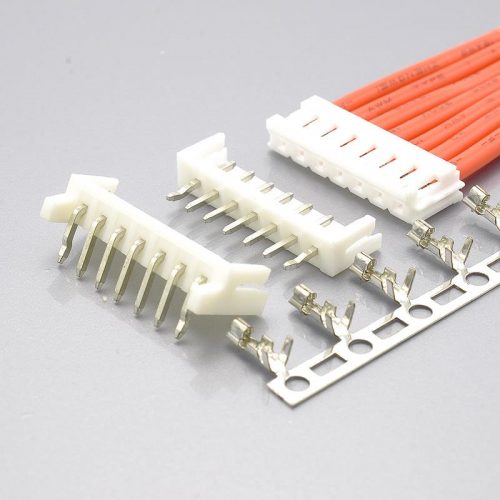
The board-mounted half. KONNRA publishes two SMT wafer images for the KR1201 — a right-angle type and a single-row type — under a single wafer component page. JST supplies the ACH header on embossed tape as an SMT part.

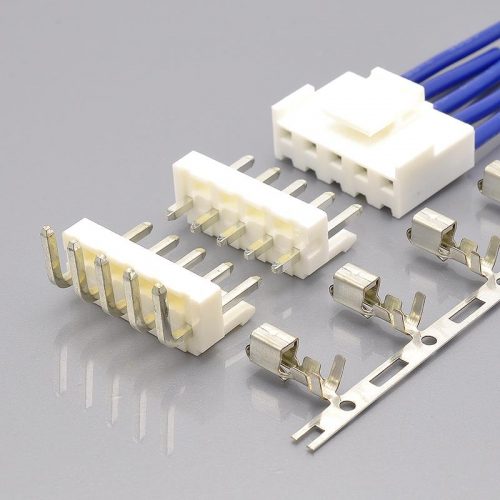
Figure 3 — KR1201 right-angle SMT wafer
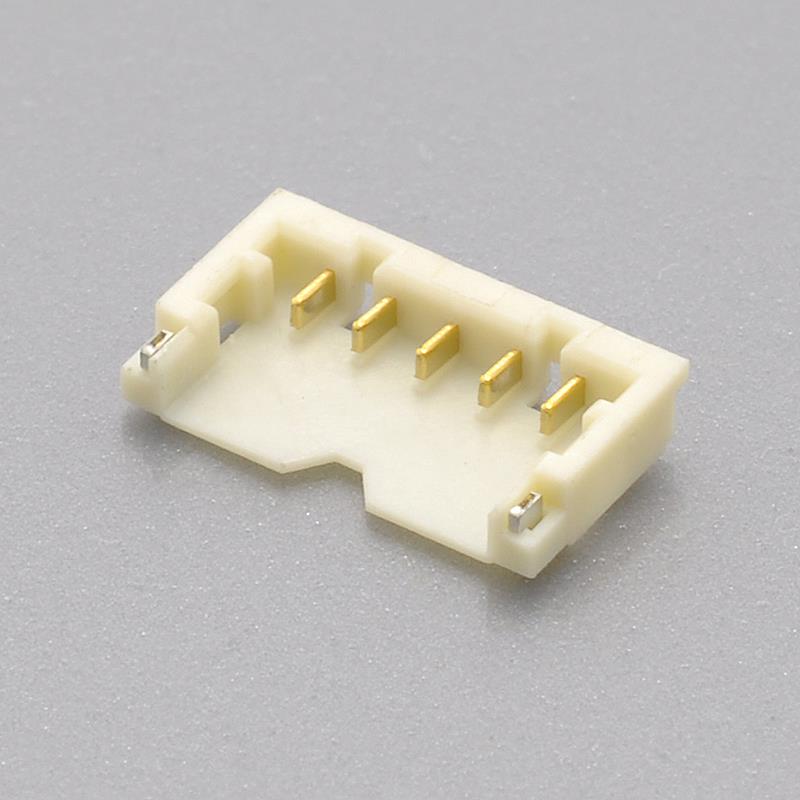
Figure 4 — KR1201 single-row SMT wafer
Check the mating geometry against your design. The ACH is a top-entry, side-feed connector: the socket mates vertically onto the header while the wires exit horizontally. That combination determines which way the harness runs across your board, and it is the reason a designer picks the ACH over a lower-profile alternative. Confirm the wafer geometry and the wire-exit direction before you commit the footprint.
Housing
The wire-side half, carrying the crimp contacts and mating onto the header.

Figure 5 — KR1201 1.20mm pitch housing
Series documentation
- KR1201 series engineering drawing (PDF)
- KR1201 product specification (PDF)
- KR1201 package specification (PDF)
➡️ Request drawings for your circuit count and wafer geometry
Crimp Contacts, Applicable Wire and Tooling
| Item | JST ACH specification |
|---|---|
| Applicable wire (series) | AWG #32 to #28 |
| Insulation O.D. (series) | 0.38 to 0.63mm |
| Crimp contact, heavier wire | SACH-003G-P0.2 — AWG #30–#28, 0.05–0.08mm², insulation 0.5–0.63mm |
| Crimp contact, finer wire | SACH-003G-P0.2B — AWG #32–#30, 0.032–0.05mm², insulation 0.38–0.5mm |
| Contact material and finish | Copper alloy, nickel-undercoated, gold-plated |
| Contact packaging | 30,000 per reel |
| Header packaging | Embossed tape |
| Housing material | PBT, UL94V-0, natural (white) |
| Crimp machine | MKS-L-10-3 · AP-K2N MKS-L-10-3 |
| Applicator | MK/SACH-003-02 · APLMK SACH003-02 |
On wire selection. JST quotes both current ratings — 2A and 1.5A — specifically at AWG #28. The series accepts wire down to AWG #32, but the current figure is not quoted at that gauge on the same line. If your harness uses #30 or #32 and you are close to the rating, confirm the applicable figure for your gauge rather than carrying the AWG #28 number across.
Crimp machine and applicator are two separate part numbers, and both are needed. JST lists the crimp machine and the applicator independently — MK/SACH-003-02 is the applicator, and APLMK SACH003-02 is the applicator supplied with dies. Ordering by applicator number alone without the machine can leave a line stalled.
What the JST ACH Is Used For
JST’s own statement is specific: the series “was originally designed for a DC power supply application”, and the applications framing is compact, low-profile connectors for applications that need high performance in tight spaces.
| Application | Why the ACH fits |
|---|---|
| DC power rails inside handheld and portable devices | The series was designed for DC power supply duty, and it carries 2A at 1–3 circuits through a 1.2mm pitch |
| Battery and power connections in compact devices | 2A capability in a 1.4mm × 4.3mm body |
| Thin enclosures where the harness must exit sideways | The top-entry, side-feed construction lets the cable run parallel to the board instead of stacking over the connector |
| Boards that go through an SMT line | The suction area on the bottom of the inside header gives an automated nozzle a placement surface |
| Tight board stacks with 1 to 5 power or signal circuits | The body grows only 1.2mm per circuit, so the layout scales predictably |
| Portable instruments and handheld medical devices | 50V rating, −25°C to +85°C range, UL Recognized and CSA Certified |
| Servers, routers and data transmission hardware | KONNRA positions its 1201 series toward board-level distribution in these products; the low profile and 2A capability suit dense boards |
What it is not for. Above 2A per contact on 1–3 circuits, or 1.5A on 4–5 circuits, the ACH is at its limit and the answer is a larger pitch rather than a different variant. And the ACH is a wire-to-board connector in the KR1201 documentation — a wire-to-wire requirement needs the separate ACH wire-to-wire variant confirmed.
JST ACH 1.2 vs the Connectors It Sits Between
The ACH occupies an unusual position: it is a 1.2mm pitch connector with a 2A rating, which puts it above every other sub-1.5mm option and below the 2mm-and-up families. Here is the map.
| Connector system | Pitch | Current | Voltage | Wire | KONNRA equivalent |
|---|---|---|---|---|---|
| JST ACH | 1.2mm | 2A (1–3 circuits) / 1.5A (4–5 circuits) | 50V AC/DC | AWG #32–28 | KR1201 |
| Molex Pico-EZmate | 1.20mm | 1.5A | 50V | AWG 28–30 | KR1200 |
| JST SH | 1.00mm | 1A | 50V AC/DC | AWG 32–28 | KR1000 |
| Molex Pico-EZmate Plus | 1.00mm | 2.8A | — | AWG 28–30 | — |
| JST GH | 1.25mm | 1A | 50V AC/DC | AWG 30–26 | KR1259 |
| JST ZH | 1.50mm | 1A | 50V AC/DC | AWG 32–26 | KR1501 |
| JST PH | 2.00mm | 2A | 100V AC/DC | AWG 32–24 | KR2004 |
| JST XH | 2.50mm | 3A | 250V AC/DC | AWG 30–22 | KR2501 |
” — ” means the figure is not verified from that manufacturer’s own documentation for this guide.
Three things this table settles:
- The ACH is the reason you do not have to go up a pitch for 2A. In the 1.0mm–1.5mm band, everything else here is 1A or 1.5A. If your requirement is 2A and you have three circuits or fewer, the ACH meets it at 1.2mm — which is the whole point of the series.
- “1.2mm” is not one connector. The JST ACH and the Molex Pico-EZmate are both 1.20mm pitch and are different systems with different housings and headers. KONNRA cross-references them as KR1201 and KR1200 respectively — two different parts for the same pitch. This is the single most common ACH sourcing error.
- Do not compare the ACH’s 1.4mm to the Pico-EZmate’s 1.55mm directly. The ACH figure is a body height; the Pico-EZmate figure is a mated height measured from the PCB. They are different measurements of different things. Compare mated height to mated height, and body height to body height.
On the 2.8A row. Molex’s Pico-EZmate Plus reaches 2.8A at 1.00mm pitch — higher current and a smaller pitch than the ACH. It achieves that with a different contact system and a different mating design. If 2A is not enough, that is worth a look before you assume the answer is a bigger connector.
Cable Assembly Options
KONNRA builds assemblies on the KR1201 interface in the standard harness configurations:
| Cable type | Description | Typical use |
|---|---|---|
| Single-headed | Housing on one end, bare wire leads on the other | Pigtail from a board header to a termination point |
| Same-side-head | Housing on both ends, same orientation | Extending a power or signal run between two boards |
| Reverse-side-head | Housing on both ends, reversed orientation | Routing through a fold or hinge |
| Adapter and transition cables | KR1201 on one end, another interface on the other — for example ACH 1.2 to Pico-EZmate 1.20mm, or ACH 1.2 to PH 2.0mm | Where the two ends of a run use different series |
Adapter harnesses matter more here than usual. The 1.2mm class contains two incompatible systems from two manufacturers, and both appear in the same products. Where a board has an ACH header and the mating end has something else, the conversion has to happen in the cable — and it has to be built to the tighter of the two pitches.
Connector lead time is typically 2–3 weeks; wiring harness lead time is typically 3–4 weeks. Key materials are prestocked, and complete connector set samples can be delivered within 45 days.
➡️ Explore KONNRA wiring harness capabilities
Sourcing the JST ACH 1.2: What Procurement Teams Ask
Engineering decides that a connector will work. Procurement decides whether the supply chain around it is safe.
“Can you be a second source without changing our design?” That is what a documented cross-reference is for. The KR1201 is specified against the JST ACH at component level — socket, header and crimp contact — with matching 1.2mm pitch, 1.4mm body height, 50V rating and 500 VAC withstanding voltage. We confirm equivalence against your specific part number, because circuit count, wafer geometry and wire gauge all change the answer.
“What are your lead times?” Connector production lead time is typically 2–3 weeks. Wiring harness lead time is typically 3–4 weeks. Key materials are prestocked.
“How long for samples?” Complete connector set samples can be delivered within 45 days. Where you need to validate crimp quality before committing — which on a 1.2mm pitch with a 0.38mm minimum insulation diameter is worth doing — sample harnesses can be supplied from the same process used in production.
“What qualifications do you hold?” ISO9001, ISO14001, IATF16949, ISO45001:2018, ISO13485, IPC620, and UL product and operational safety certifications. Automotive-grade series additionally hold LV214 and US CAR-2.
“How do we know the parts match your documentation?” A CNAS-accredited laboratory with 45+ sets of precision testing instruments, with dimensional and electrical verification data available on request. 95% of production processes carry full-line intelligent visual CCD inspection; automotive series receive 100% CCD inspection.
“Are you a manufacturer or a trader?” A manufacturer. Dongguan Konnra Electronics Co., Ltd., founded 2004, with in-house mould design, injection moulding, stamping, assembly, and inspection — so the connector and the cable assembly come from one quality system.
“What volumes can you support?” KONNRA reported 2025 sales of RMB 310 million, with connectors at 60% and wiring harnesses at 40% of the product mix, across four production bases with automation coverage exceeding 95%.
“Who else buys from you?” KONNRA states that it serves global cooperative clients including BYD, Volkswagen, and DJI.
➡️ Request the vendor qualification pack — certificates, test capability summary, product drawings, and a sample plan in one enquiry.
How to Get a Cross-Reference Check on Your ACH Part Number
Most ACH enquiries stall on the same thing: the buyer is not sure what information the supplier needs, so the enquiry never gets sent. Here is the complete list.
Send us:
- The original part number, if you have it — a socket such as
ACHR-…V-S, a header such asBM…B-ACHSS-GAN-TF, or a contact such asSACH-003G-P0.2 - Circuit count — the ACH is documented from 1 to 5, and the current rating changes at four circuits
- Your load current, so the 2A versus 1.5A question can be settled for your circuit count rather than quoted as a family figure
- Wire specification — gauge and, critically, insulation outside diameter. The ACH window is 0.38–0.63mm and the two crimp contacts split it
- Whether you need the connector only or a finished harness, and if a harness, the length and the far-end termination
- Wafer geometry and wire-exit direction — the top-entry, side-feed construction decides which way the harness leaves the board
- Application and annual volume, so configuration, tooling and packaging can be matched to your programme
- A drawing or photo, if the part number is unreadable or the design has been reverse-engineered
When you send a part number, we will confirm four things against JST’s own documentation: the current rating for your circuit count, the crimp contact that matches your wire and insulation, the wafer geometry and exit direction, and the insulation outside diameter window. Those four are where an ACH cross-reference most often goes wrong.
What you get back: a mapped KONNRA part number with the relevant product and engineering drawings, a specification comparison against your original part, and a sample and quote plan.
Engineer’s Pre-Release Checklist
Run this before you release a drawing for an ACH-family connector.
- Pitch measured, not assumed. 1.2mm is JST ACH or Molex Pico-EZmate. 1.25mm is JST GH or Molex PicoBlade. 1.00mm is JST SH. None of them mate.
- Current rating checked against your circuit count — 2A at 1–3 circuits, 1.5A at 4–5 circuits. Not a single family number.
- Circuit count confirmed — the ACH is documented from 1 to 5; the KONNRA KR1201 range is stated as 2~7P. Confirm the count you intend to order.
- The correct crimp contact selected —
SACH-003G-P0.2for AWG #30–28 at 0.5–0.63mm insulation,SACH-003G-P0.2Bfor AWG #32–30 at 0.38–0.5mm. In the AWG #30 band, the insulation diameter decides, not the conductor gauge. - Insulation outside diameter inside 0.38–0.63mm — and note the KONNRA documentation publishes only a 0.75mm maximum, with no minimum.
- Contact resistance compared on the same basis — JST publishes 10mΩ max initial and 20mΩ max after environmental tests; KONNRA publishes the 20mΩ figure.
- Operating temperature judged against the right definition — JST’s −25°C to +85°C includes the temperature rise from current flow, which is stricter than a bare ambient range.
- Wafer geometry and wire-exit direction matched to your layout, including which way the harness leaves the board.
- Body height and width checked against the enclosure — 1.4mm height, with width growing 1.2mm per circuit.
- Housing material confirmed against your process or customer requirement — JST specifies PBT UL94V-0, KONNRA documents PA66 / LCP.
- UL Recognized status confirmed if your qualification names it — JST cites E60389 and CSA LR20812.
- Crimp machine and applicator identified together if you crimp in-house, and ask which applicator the KR1201 terminal is validated against.
- Gold thickness confirmed in microns if your specification names one — neither document states it.
- Wire-to-board or wire-to-wire confirmed — the KR1201 documentation covers the wire-to-board path.
➡️ Send us your drawing. We will review it against the KR1201 specification and come back with any mismatch we find — before you commit tooling. Submit a drawing for review
Why Source ACH 1.2 Connectors from KONNRA
Dongguan Konnra Electronics Co., Ltd. (brand: KONNRA) was founded in 2004 and is a National High-Tech Enterprise specialising in connector and wiring harness research, development, production, and sales.
Manufacturing depth. A vertically integrated process covering precision mould design and manufacturing, automation design, precision injection moulding, stamping, assembly, and CCD visual inspection. Automation coverage exceeds 95% across production lines.
Testing and validation. A CNAS-accredited laboratory with 45+ sets of precision testing instruments, and CAE analysis — contact nonlinear analysis, material nonlinear analysis, motion simulation, thermal field analysis, and high-frequency analysis — performed in Ansys 2022 R1. Verification data is available on request.
Inspection coverage. Full-line intelligent visual CCD inspection covers 95% of production processes, using Mitsubishi and Panasonic PLC control systems with FA25–35mm optical lenses and 5-megapixel cameras. Automotive connector series receive 100% CCD visual inspection.
Quality systems. ISO9001, ISO14001, IATF16949, ISO45001:2018, ISO13485, IPC620, and UL product and operational safety certifications, with automotive-grade series additionally certified to LV214 and US CAR-2.
Capacity and delivery. Production bases in Dongguan Wangniudun (30,000 m², 350+ employees), Dongguan Changan (10,000 m², 150+ employees), and Hunan Daoxian (2,600 m², 100+ employees), with regional offices in Beijing, Chongqing, Hunan, Shanghai, and Kunshan. Key materials are prestocked, and complete connector set samples can be delivered within 45 days. KONNRA reported 2025 sales of RMB 310 million, with connectors at 60% and wiring harnesses at 40% of the product mix, and has served global cooperative clients including BYD, Volkswagen, and DJI.
Custom and joint R&D. Where a standard part does not fit — a non-standard harness length, a transition to another interface, or a specific plating thickness requirement — KONNRA supports customer joint R&D customisation.
How to Identify Whether Your Connector Is a JST ACH
If you are holding a connector and a drawing you cannot match, work through these in order:
- Measure the pitch. 1.2mm points at JST ACH or Molex Pico-EZmate. 1.25mm points at JST GH or Molex PicoBlade. 1.00mm points at JST SH.
- Count the positions. JST documents the ACH in 1 to 5 circuits. A 6- or 7-position 1.2mm connector is not a standard ACH.
- Measure the connector height. The ACH header stands 1.4mm off the board.
- Check the mating direction and the wire exit. This is the signature: the socket mates from above, and the wires leave horizontally. A connector that mates vertically with wires leaving vertically is not an ACH.
- Check the body width. The ACH grows 1.2mm per circuit — 2 circuits measure 1.2mm across the mounting centres, 5 circuits measure 4.8mm.
- Look for the suction area on the bottom of the inside header. It is a flat pad sized for a pick-and-place nozzle and is a good confirmation cue.
- Read the part number if there is one.
ACHR-…V-Sis the socket,BM…B-ACHSS-GAN-TFis the header, andSACH-003G-P0.2/SACH-003G-P0.2Bare the crimp contacts.
If you are still unsure, photograph the connector next to a ruler, with any part number markings visible, and send it to us. At this pitch, the measurement identifies the family; the part number identifies the variant.
Frequently Asked Questions
What is a JST ACH connector?
The JST ACH is a 1.2mm pitch, single-row, disconnectable crimp-style wire-to-board connector with a 1.4mm height and 4.3mm width, available in 1 to 5 circuits. JST states it was originally designed for a DC power supply application, and its defining construction is top entry but side feed.
What is the current rating of the JST ACH?
2A AC/DC for 1 to 3 circuits and 1.5A AC/DC for 4 and 5 circuits, both quoted with AWG #28 wire. The rating is circuit-count dependent, so quoting a single figure is incomplete — and this is the ACH’s headline feature, since 2A at 1.2mm pitch is unusual.
What does “top entry but side feed” mean?
The socket mates with the header from the vertical direction — it comes straight down onto the board — while the wires exit from the horizontal direction of the socket. The result is vertical mating with a cable that runs parallel to the board, which means the harness does not consume the connector’s 1.4mm height with its bend radius.
What is the KONNRA equivalent of the JST ACH?
The KONNRA KR1201 series — a 1.2mm pitch single-row wire-to-board connector documented at 1.5A and 50V with a stated range of 2 to 7 positions, offered as a housing, a right-angle wafer and a terminal.
How many circuits does the JST ACH come in?
JST documents the ACH in 1, 2, 3, 4 and 5 circuits. KONNRA documents the KR1201 as 2~7P, which is wider than the original at the top end and does not cover the single-circuit option.
What wire does the JST ACH use?
AWG #32 to #28, with an insulation outside diameter of 0.38 to 0.63mm. The series figure is a union of two crimp contacts’ windows: SACH-003G-P0.2 covers AWG #30–28 at 0.5–0.63mm insulation, and SACH-003G-P0.2B covers AWG #32–30 at 0.38–0.5mm.
Which ACH crimp contact do I need?
It depends on both the conductor and the insulation. Both contacts cover AWG #30, so in that band the insulation outside diameter decides: 0.5mm and above uses SACH-003G-P0.2, below 0.5mm uses SACH-003G-P0.2B. Selecting by conductor gauge alone is ambiguous at #30.
What is the height and width of the JST ACH?
1.4mm high and 4.3mm wide, per JST’s series description. The body length grows by 1.2mm per circuit — the mounting centres measure 1.2mm at 2 circuits and 4.8mm at 5 circuits.
What is the voltage rating of the JST ACH?
50V AC/DC.
What is the temperature range of the JST ACH?
−25°C to +85°C, and JST states this range includes the temperature rise caused by current flow — a stricter definition than a bare ambient range. KONNRA documents −40°C to +105°C for the KR1201, which is wider; ask for test data if you intend to rely on it.
What is the withstanding voltage of the JST ACH?
500 VAC per minute — and on this parameter the JST and KONNRA documents agree, which is worth stating because it is not a given. The datasheet also specifies insulation resistance of 100MΩ min and contact resistance of 10mΩ max initial, 20mΩ max after environmental tests.
Does the ACH come in a wire-to-wire version?
Yes. JST publishes separate ACH wire-to-wire documentation describing a disconnectable crimp-style wire-to-wire connector at the same 2A and 50V headline ratings. The KONNRA KR1201 documentation covers the wire-to-board path, so a wire-to-wire requirement needs separate confirmation.
Is the JST ACH the same as Molex Pico-EZmate?
No. Both are 1.20mm pitch, and they are different connector systems with different housings and headers — they do not mate. KONNRA cross-references them as KR1201 (ACH) and KR1200 (Pico-EZmate). The pitch is the same; nothing else is.
Can the JST ACH be placed by machine?
Yes. JST provides a suction area on the bottom of the inside header sized for a pick-and-place nozzle, so the ACH can go through a standard SMT line. The header is supplied on embossed tape.
What standards does the JST ACH hold?
UL Recognized E60389 and CSA Certified LR20812, and the series is RoHS compliant.
How long does it take to get samples?
KONNRA can deliver complete connector set samples within 45 days. Connector production lead time is typically 2–3 weeks and wiring harness lead time typically 3–4 weeks.
Start Your Cross-Reference Check
KONNRA supplies the KR1201 series as individual components or as complete pre-crimped cable assemblies, and builds adapter and transition harnesses to order.
- Request a quote — KR1201 pricing, MOQ and configuration options for your circuit count and wafer geometry
- Request a sample — complete connector set samples within 45 days
- Request cross-reference verification — confirm KR1201-to-ACH equivalence against your specific part number, including the current rating for your circuit count
- Request drawings — series engineering drawing, product specification and package specification
- Request a vendor qualification pack — certificates, test capability summary and quality documentation
- Request adapter harnesses — ACH 1.2 to Pico-EZmate 1.20mm, ACH 1.2 to PH 2.0mm, or another interface on the far end
- Submit a drawing for review — we will flag any specification mismatch before you commit tooling
Contact KONNRA Electronics
- Phone: (86)-769-85449875
- Email: [email protected]
- Address: No.6 Nanchang South Road, Chijiao, Wangniudun, Dongguan, Guangdong, China
- Contact us
➡️ Explore the full 1.2mm pitch range · JST connector alternatives · Wire-to-board connector catalogue
Sources and method. JST ACH figures are taken from JST’s own published documentation for the series: the description as a compact and low-profile 1.2mm pitch wire-to-board connector with a 1.4mm height and 4.3mm width; the statement that the series was originally designed for a DC power supply application and has a 2.0A rating for both the 2 and 3 circuits using 28 AWG wire; the current rating of 2A for 1 to 3 circuits and 1.5A for 4 and 5 circuits at AWG #28; the 50V AC/DC voltage rating; the −25°C to +85°C temperature range including temperature rise from current flow; contact resistance of 10mΩ max initial and 20mΩ max after environmental tests; insulation resistance of 100MΩ min; a withstanding voltage of 500 VAC per minute; an applicable wire range of AWG #32 to #28 with an insulation outside diameter of 0.38 to 0.63mm; the two crimp contacts SACH-003G-P0.2 (AWG #30–28, 0.05–0.08mm², insulation 0.5–0.63mm) and SACH-003G-P0.2B (AWG #32–30, 0.032–0.05mm², insulation 0.38–0.5mm) at 30,000 per reel; the contact material and finish of copper alloy with a nickel undercoat and gold plating; the housing material of PBT, UL94V-0, natural (white); the circuit counts of 1 to 5 with their A and B dimensions; the UL Recognized E60389 and CSA Certified LR20812 standards; the top entry but side feed construction; the suction area on the bottom of the inside header for pick-and-place nozzles; the embossed tape header packaging; the crimp machine and applicator part numbers (MKS-L-10-3, AP-K2N MKS-L-10-3, MK/SACH-003-02, APLMK SACH003-02); and the RoHS statement. The wire-to-wire ACH variant is taken from JST’s separate ACH1 wire-to-wire documentation. The Molex Pico-EZmate, Pico-EZmate Plus and PicoBlade figures in the comparison table are taken from Molex’s published product information, and the JST SH, GH, ZH, PH and XH figures from JST’s own series documentation. KONNRA KR1201 specifications, component pages and download links are taken from KONNRA’s published product and component documentation. Where the two sources disagree, or where a figure differs between two places on the same source, the difference is stated in this guide rather than smoothed over. Always confirm final dimensional and electrical requirements against the current manufacturer drawing for your specific part number.