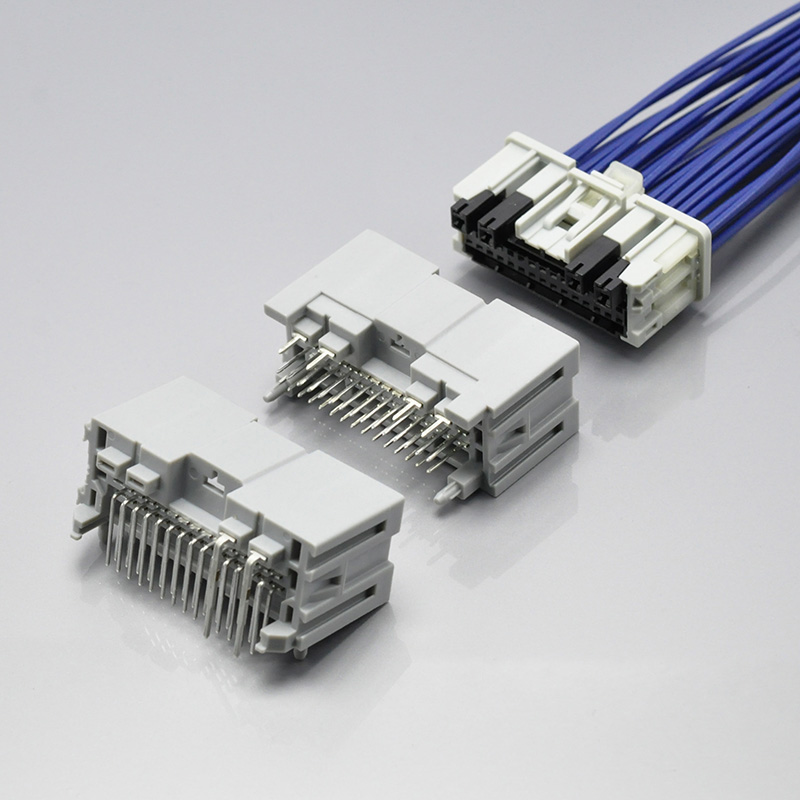
Quick answer: Molex Mini50 is a USCAR-050 automotive wire-to-board system built on the compact 0.50mm CTX50 terminal, in single, dual and three-row versions. The three-row 34/38-circuit version — the one this article is about — is 2.00mm pitch, rated 4.0A max, −40°C to +105°C, unsealed (classification S1), and plated tin over nickel. The KONNRA KR2021 is its cross-reference equivalent in the 30+4P and 30+8P hybrid configurations, meaning 34 and 38 circuits in three rows.
Three things decide whether this replacement works, and the first one is a number the two KONNRA documents disagree about by a factor of eighteen.
The first: KONNRA’s specification says the rated voltage is 14V. KONNRA’s web pages say 250V. Section 4.0 of PS-KR2021-01 states Rated Voltage (Max.) 14V AC/DC. Molex’s own specification for the same 3-row system states “Maximum Operating Voltage: 14 VDC”. So the specification and the original agree — and the product page and both component pages are the outliers at 250V. See section 2.
The second: the cross-reference mixes the sealed and the unsealed Mini50 systems. The housing page names 34959, which Molex classifies S1 (Unsealed), while listing Molex part numbers from the 2133820340 family, which is the sealed series. The product page meanwhile advertises a “matte sealing design” meeting IPX8. Those three statements cannot all be true of one part.
The third: the specification publishes no board-side header. The part-number table lists “MX Header Housings” and “PIN” as / — empty — even though the materials table describes the header resin and the product page displays four wafer images.
One naming note before the table. You may have arrived here looking for a Molex MX34C. MX34C is a JAE Electronics series, not a Molex one, and KONNRA documents no JAE cross-reference anywhere on its site. Everything below is anchored to what KONNRA and Molex both actually publish: the Molex Mini50 system. If your design is on a JAE MX34C, this is a different cross-reference and the numbers will not line up.
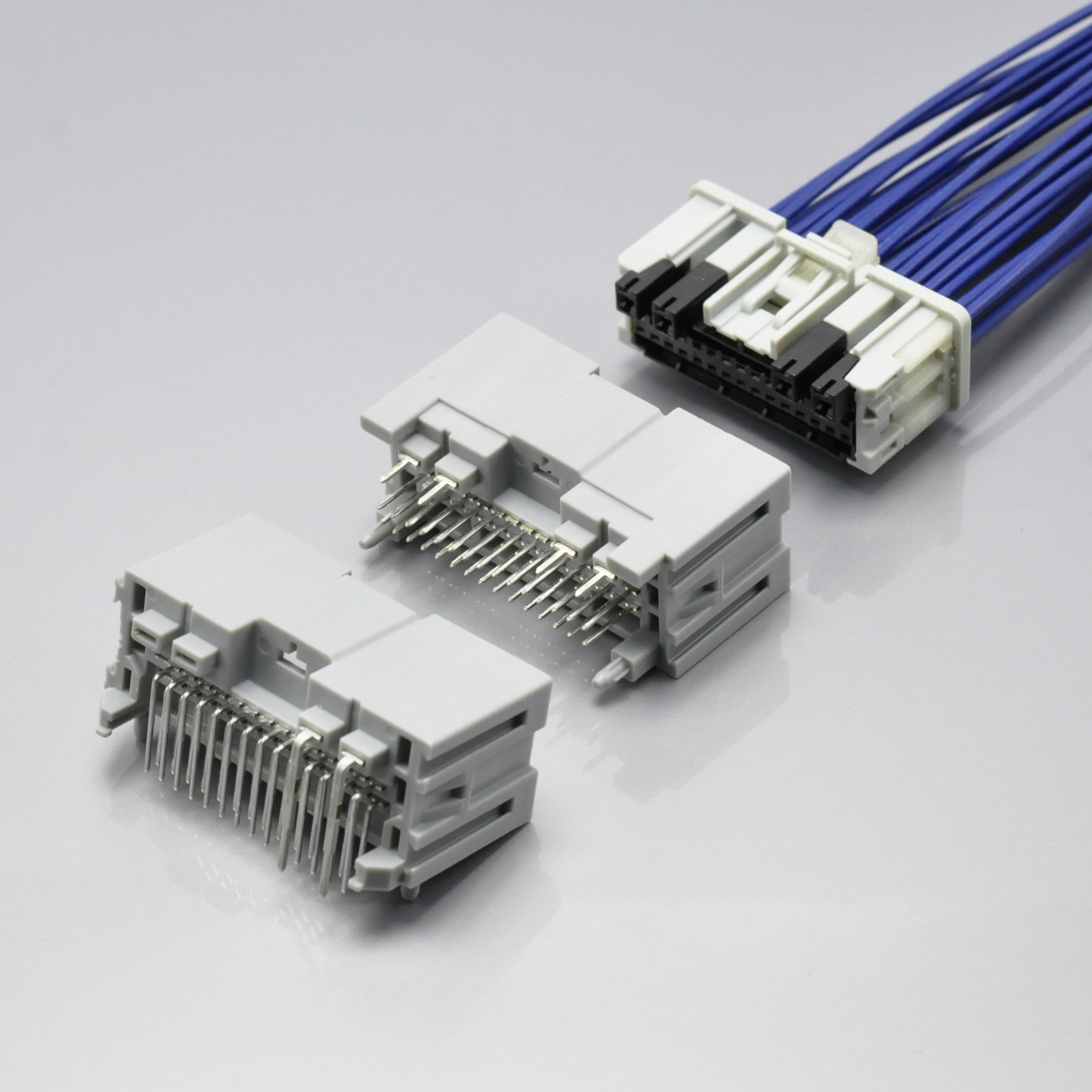
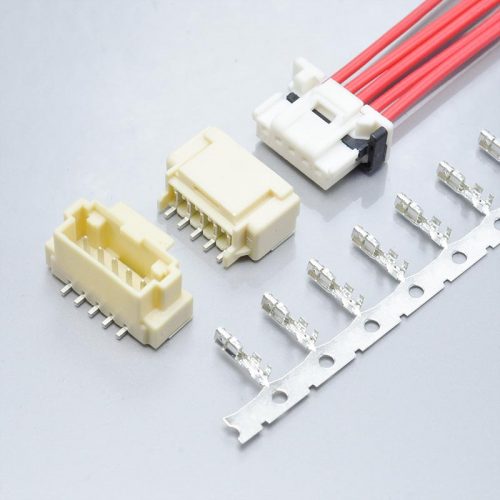
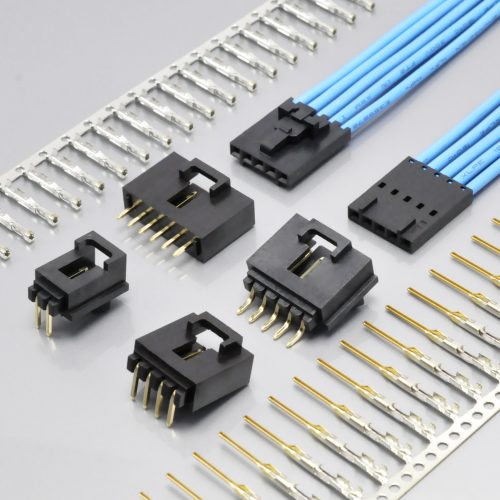
KONNRA KR2021 series Mini50 wire-to-board CPA car connector, the cross-reference equivalent for the Molex Mini50 3-row system
At a glance
| Item | Molex Mini50, 34/38-circuit 3-row | KONNRA KR2021 |
|---|---|---|
| Pitch | 2.00mm | 2.00mm |
| Rows | 3 | 3 |
| Circuits | 34 (hybrid) and 38 | 34P and 38P (specified as 30+4P / 30+8P) |
| Application | Wire-to-board, USCAR-050 interface | Wire-to-board |
| Rated / operating voltage | 14 VDC max operating | 14V per specification · 250V per web pages |
| Current, max | 4.0A | 4A |
| Operating temperature | −40 to +105°C (T2) | −40 to +105°C |
| Temperature rise over ambient | +55°C max | +55°C max |
| Sealing classification | S1 — Unsealed | not published |
| Vibration classification | V1 (body / sprung masses) | not published |
| Contact resistance | 20mΩ max | 20mΩ per specification · 15mΩ per web pages |
| Insulation resistance | 100MΩ min | 100MΩ min |
| Dielectric withstanding | 1500V AC min (family table) | 1000V AC for 1 minute |
| Durability | 10 mating cycles (tin) | 10 mating cycles |
| Wire range | 0.13 to 0.35mm² (22 to 26 AWG) | crimp table covers 24 / 26 / 28 AWG; pages say 22#–24# |
| Insulation diameter | 0.89 to 1.40mm | 1.40mm max |
| Housing resin | PA66 GF35 | PA66 GF35% |
| TPA / CPA resin | PA66 GF50 | PA66 GF50% |
| Header housing resin | SPS GF30 | SPS GF30% |
| Header pin material | C26800 (brass) | BRASS |
| Plating | Tin, nickel under-plate | Tin/Gold over nickel |
| Agency | UL / CSA / TUV: “Not Applicable” | UL E326732 (terminal page) · UL E482542 (housing page) |
| IR reflow | +260°C, 3 cycles | +260°C maximum |
| Solderability | 95% minimum (SMES-152) | 95% minimum (SMES-152) |
Five rows in that table need a note before you build on them.
The voltage row is the important one and it gets its own section. The specification and the original agree at 14V; the web pages say 250V.
The contact-resistance row has the same shape of problem, in the same direction. The specification says 20mΩ max, which matches Molex exactly. The product page and both component pages say 15mΩ max — a number better than the original’s, and not supported by KONNRA’s own controlling document.
The sealing row is blank on the KONNRA side, which is a problem given that the page advertises IPX8. Molex publishes a sealing classification for this system — S1, Unsealed. KONNRA publishes none, so there is nothing to check the page’s claim against.
The withstanding row runs against the replacement. The Mini50 family datasheet gives a 1500V AC minimum dielectric withstanding voltage. KONNRA’s specification requires 1000V AC for one minute. Both are AC values for one minute, so this is a like-for-like difference and the replacement is lower.
The agency row is inconsistent on both sides. KONNRA’s two component pages for one series give two different UL file numbers — E326732 on the terminal page and E482542 on the housing page. And on the Molex side, the product specification for this exact 3-row system records “Not Applicable” against UL File Number, CSA File Number and TUV License Number.
The rated voltage is 14V, not 250V
This is the most consequential finding in this comparison, and it is unusual because the error runs the opposite way from the usual marketing drift.
What KONNRA’s specification says — PS-KR2021-01, section 4.0, “Ratings and applicable wires”:
| Item | Specification |
|---|---|
| Rated Voltage (Max.) | 14V AC/DC |
| Rated Current (Max.) | 4A AC/DC |
| Ambient temperature range | −40°C to +105°C |
What Molex’s specification says — PS-34959-001 revision B, section 5.1 “VOLTAGE – OPERATING”:
“Maximum Operating Voltage: 14 VDC” Note: “Listed maximum operating voltage is used to establish maximum current. Higher operating voltages can be used but must be reevaluated to establish maximum allowable current”
And what KONNRA’s web pages say:
| KONNRA source | Voltage published |
|---|---|
Product specification PS-KR2021-01, section 4.0 |
14V AC/DC |
| Product page, at-a-glance table | 250V |
| Terminal component page | 250V |
| Housing component page | 250V |
The specification and the original manufacturer agree at 14V. Three web pages say 250V. That is a factor of roughly eighteen, and it is the specification — not the page — that matches Molex.
Why this is more serious here than in a comparable documentation dispute. The Mini50 34/38-circuit system is an automotive interior connector, and 14 VDC is not an arbitrary figure: it is the maximum operating voltage that Molex uses to establish the current rating. Molex’s own footnote says so explicitly — the 14V figure is the basis on which the 4.0A rating stands, and “higher operating voltages can be used but must be reevaluated to establish maximum allowable current”.
So the 14V and the 4A are one number, not two independent claims. A designer who reads 250V off the KONNRA page and selects this part for a higher-voltage circuit is not merely exceeding a voltage limit — they are invalidating the current rating on which the rest of the selection rested. And they would be doing it on the strength of a figure that appears nowhere in the controlling document.
What to do about it. Treat 14V as the rated voltage, because that is what the specification says and what the original says. And raise the discrepancy with the supplier, because a factor-of-eighteen error on a rated voltage is not a rounding matter — either the pages are wrong, or the specification is, and the answer changes which circuits the part can be used on. It is the first question in the checklist at the end of this article.
One thing that is not in dispute. The dielectric withstanding voltage is specified at 1000V AC for one minute (section 5.4, per EIA-364-20A), and the product page quotes the same 1000V AC figure. Withstanding voltage and rated voltage are different parameters, and a 1000V withstanding figure alongside a 14V rated voltage is not itself a contradiction. But it does explain how a 250V figure could have been mistaken for the rating: the page carries both a “Voltage: 250V” row and a “Withstanding Voltage: 1000V AC/minute” row, and neither matches the specification’s 14V.
The cross-reference mixes the sealed and the unsealed Mini50 systems
Molex publishes Mini50 as a family with sealed and unsealed branches, and the 34/38-circuit three-row system is the unsealed one. Its product specification says so in three independent places:
| Molex source | What it says |
|---|---|
PS-34959-001 section 1.0, Scope |
“the 2.00 mm (0.079 inch) centerline (pitch) three row Mini50 0.50 & 1.20mm hybrid and non-hybrid unsealed wire to board connection system” |
| Section 5.4, Classification | “Sealing Classification: S1 (Unsealed)“ |
| The Mini50 family datasheet | “Mini50 Unsealed Connector System” |
Now compare what KONNRA publishes about the same cross-reference:
| KONNRA source | What it says |
|---|---|
| Housing component page, “Compatible” field | 34959 Series — Molex’s unsealed 3-row system |
| Housing component page, cross-reference table | Molex 2133820340 / 2133820341 / 2133820342 — the sealed Mini50 housing family |
| Product page, Advantages | “The advanced matte sealing design meets IPX8 protection requirements and is suitable for a wide range of sealed applications.” |
| This article’s subject | Molex’s 34959 system is unsealed |
Three statements from one supplier that cannot all be true of one part. The housing page’s own “Compatible” field names the unsealed system while its cross-reference table names sealed part numbers; and the product page advertises the sealed system’s signature feature.
What IPX8 means here, and why the discrepancy matters. IPX8 is an immersion rating. It is the headline property of Molex’s sealed Mini50 range — a different product family with a different housing, a different interface and a different part numbering series. A 34959-based system is, by Molex’s own classification, S1 Unsealed, and no amount of terminology makes an unsealed connector immersion-rated.
The practical risk is a wrong system, not a wrong number. A customer who needs a sealed interface and reads the KR2021 page may conclude this is the sealed cross-reference. A customer replacing an unsealed 34959 who reads the cross-reference table may order against a sealed part number. Both fail, and neither fails loudly — the parts look similar and share a terminal system.
What to establish before specifying:
- Decide which you actually need. An unsealed interior connector (headliners, clusters, switches, HVAC, lighting) against a sealed one (exterior, underhood, wash-down). Molex makes both; they are not interchangeable.
- If unsealed, the relevant Molex references are the 34959 receptacle, the 34958 vertical two-bay header, the 34961 right-angle header and the 34960 stacked headers, with the 560023 CTX50 terminal.
- If sealed, the 2133820340 family is the housing, and it is not the same connector.
- Ask KONNRA which of their components carries the IPX8 claim, since the specification for this series states no sealing classification at all.
The specification publishes no board-side header
This one is easy to miss because the product page contradicts it, and it decides whether the KR2021 is a complete replacement or half of one.
Section 2.0 of PS-KR2021-01, “Spec and Part number”, lists these:
| Component | Part number |
|---|---|
| Housing / Bottom Housing | H20210***240*A |
| TPA / CPA | H202121342401A / H202131342401A |
| Terminal | T20210C***01A |
| MX Header Housings | / |
| PIN | / |
The board-side header housing and its pins are listed as / — empty. The specification does not publish a part number for either.
But the same specification’s materials table does describe them, as does the product page and every other KONNRA artefact for this series:
| Source | Board-side evidence |
|---|---|
| Specification section 3.0, materials | “MX Header Housings: SPS GF30%, UL94 V-0/HB” and “Conductor / Contact: BRASS, Tin/Gold Plated Over Nickel” |
| Product page | Displays four wafer images: Straight DIP, Right Angle DIP, 3-Row DIP and 3-Row Right Angle DIP |
| Molex, for comparison | Header housings SPS GF30; pins and blades C26800; tin with nickel under-plate |
So the material and plating of the header are documented in detail, while its part number is not published at all. The most likely reading is that the header is supplied — the materials table would be pointless otherwise — but that the part number is either omitted from this document or issued separately. The documents do not settle it, and it is not a question to leave open.
Why it matters more on this series than on others. On the adjacent series in this catalogue, the header and the housing are both published, so a designer can cross-reference a complete mating pair from one set of documents. Here the header is the most distinctive part of the system — the Mini50 header carries the orientation features molded into it for wire-routing flexibility and the board alignment and retention features that hold it during soldering. If you cannot cross-reference the header, you cannot complete the board side of the design.
Also worth knowing on the header side: Molex’s 3-row headers come in more configurations than a single part number covers. The family listing shows 34958 (three-row vertical / right-angle / two-bay stacked, through-hole), 34961 (the same range) and 34960 (two-bay and three-bay stacked, covering 68 hybrid-hybrid, 72 hybrid-three-row and 76 three-row-three-row). If your board uses a stacked or multi-bay header, confirm it is in scope.
The terminal retention requirement is stated in the opposite direction
This is the most technically interesting finding in the comparison, and it is a direct consequence of one word: whether a retention figure is a floor or a ceiling.
Molex states terminal retention in both directions, deliberately:
| Molex terminal | TPA position | Molex requirement |
|---|---|---|
| 0.50mm (signal, CTX50) | Un-locked | 15N MAXIMUM |
| 0.50mm (signal, CTX50) | Final-lock | 30N MINIMUM |
| 1.20mm (power, TE MCON) | Un-locked | 30N MAXIMUM |
| 1.20mm (power, TE MCON) | Final-lock | 40N MINIMUM |
The logic is straightforward once you see it. The un-locked figure is a ceiling — with the secondary lock open, the terminal must be removable, so its retention must not exceed 15N. The locked figure is a floor — with the lock engaged, retention must be at least 30N. A maximum for the open state and a minimum for the closed state.
KONNRA states both as minimums:
| KONNRA item | Requirement |
|---|---|
| Terminal retention, TPA in Un-Lock | 20 Newtons MINIMUM |
| Terminal retention, TPA in Final-Lock | 55 Newtons MINIMUM |
For the 0.50mm signal terminal, KONNRA’s un-locked floor of 20N is above Molex’s un-locked ceiling of 15N. A joint cannot be required to be at least 20N and no more than 15N. One of the two documents has the direction wrong, and the Molex document is the one that carries a revision note about having corrected exactly this:
Revision A3, Jul-03-2021: “Updated the item of terminal insertion force requirement: 0.50mm (TPA in Un-lock): 15N Max. WAS 15N Min.; 0.50mm (TPA in Final-Lock): 30N Min. WAS 30N Max.; 1.20mm (TPA in Un-lock): 30N Max. WAS 30N Min.; 1.20mm (TPA in Final-Lock): 40N Min. WAS 40N Max.“
Molex swapped min and max across all four figures in 2021 — so this is a documented trap in the family, and any cross-reference written before that revision carries the old (inverted) direction. KONNRA’s figures use minimums for both states, which matches the pre-revision pattern for the un-locked case.
And there is a second, simpler gap in the same clause: KONNRA publishes one figure where the connector has two terminals. A 30+4P hybrid connector contains thirty 0.50mm signal terminals and four 1.20mm power terminals — and the 1.20mm terminal is a TE MCON part in Molex’s own system, not a Molex one. Molex therefore publishes separate retention figures for each terminal size, as the table above shows.
KONNRA publishes a single un-locked figure and a single locked figure, and lists a single terminal part number (T20210C***01A) in section 2.0. So for a hybrid design the power terminals are not covered — neither by a part number nor by a retention specification. See the wire-range section below, which has the same shape.
On the locked figures, KONNRA is the more demanding of the two — 55N against Molex’s 30N (0.50mm) and 40N (1.20mm). That is a stronger requirement in the direction that matters for retention. The problem is not that the number is low; it is that one of the two numbers has the sign of the requirement the wrong way round, and that a hybrid connector is being specified with one terminal’s worth of figures.
Where the two systems match
The overlap is substantial, and it covers the parameters an automotive design actually gates on.
| Parameter | Molex Mini50 34/38 | KONNRA KR2021 | Match |
|---|---|---|---|
| Pitch | 2.00mm | 2.00mm | Exact |
| Rows | 3 | 3 | Exact |
| Circuits | 34 (hybrid) / 38 | 34P / 38P (30+4P, 30+8P) | Exact |
| Application | Wire-to-board | Wire-to-board | Exact |
| Current, max | 4.0A | 4A | Exact |
| Operating temperature | −40 to +105°C (T2) | −40 to +105°C | Exact |
| Temperature rise over ambient | +55°C max | +55°C max | Exact |
| Insulation resistance | 100MΩ min | 100MΩ min | Exact |
| Durability | 10 mating cycles (tin) | 10 mating cycles | Exact |
| Solderability | 95% min (SMES-152) | 95% min (SMES-152) | Exact |
| IR reflow | +260°C | +260°C max | Exact |
| Insulation diameter, max | 1.40mm | 1.40mm max | Exact |
| Housing resin | PA66 GF35 | PA66 GF35% | Exact |
| TPA / CPA resin | PA66 GF50 | PA66 GF50% | Exact |
| Header housing resin | SPS GF30 | SPS GF30% | Exact |
| Header pin material | C26800 (brass) | BRASS | Equivalent |
| Agency test regime | USCAR-2, GMW3191, SMES-152, ES-40000-5013 | GMW3191, SMES-152, EIA-364-52, 1008-hour exposure | Overlapping |
Seventeen rows, and the material rows are the striking part. KONNRA’s specification reproduces Molex’s material callouts exactly — PA66 GF35 for the harness housing, PA66 GF50 for the TPA and CPA, SPS GF30 for the header housing, and brass for the pins. Those are not generic polymer families; they are filled-and-specified grades with glass content, and they match the original line for line. On this axis the documentation is unusually strong.
The environmental programme is also a genuine match, and it is worth seeing side by side. Molex’s Mini50 is validated to a USCAR-2 and GMW3191 regime; KONNRA’s specification runs the same tests:
| Test | Molex | KONNRA |
|---|---|---|
| Durability preconditioning | 10 mating cycles | 10 cycles before environmental tests |
| Thermal shock | class 2, 300 and 600 cycles | 300 cycles of −40°C / +105°C, 30 min each |
| High-temperature exposure | 1008 hours | 1008 hours at 105°C |
| Humidity | GMW3191 profile | GMW3191 2012 temperature/humidity profile |
| Humid heat constant | — | 10 days at 85±3°C and 90±5% RH |
| Vibration | USCAR-2, not coupled to engine | 22 hours/axis at 2.13 Grms, 132 shocks at 25 G, 3 shocks at 100 G |
| Solderability | 95% min per SMES-152 | 95% min per SMES-152 |
| IR soldering | +260°C, 3 cycles | +260°C maximum |
Where the number of cycles differs, read it carefully. Molex lists thermal shock as “class 2, 300 & 600 cycles“; KONNRA specifies 300. So the replacement is qualified to the shorter of the two durations Molex lists. For most automotive interior applications 300 cycles is the applicable figure, but if your requirement cites the 600-cycle case, that is a difference to raise rather than assume.
One match worth calling out as stronger than it looks: the temperature rise. Both specify +55°C maximum over ambient, and Molex reaches that figure through “temperature rise over ambient < 55C” under USCAR-2 and Fiat 7-Z8260. KONNRA’s specification adds a preconditioning step worth knowing about — the rise is measured after 1008 hours of bench-top testing on a 45-minutes-on / 15-minutes-off cycle. That is a more demanding basis than a cold measurement, and getting the same +55°C after it is a meaningful equivalence.
And the current rating is genuinely the same. 4.0A on both sides — but note from the voltage section that the 4.0A and the 14V are tied together in Molex’s data, since the maximum operating voltage is what establishes the maximum current. The current match is only meaningful at or below 14V.
Where the two systems differ
| Parameter | Molex Mini50 34/38 | KONNRA KR2021 | Nature of the difference |
|---|---|---|---|
| Rated operating voltage | 14 VDC max | 14V per spec · 250V per pages | Pages contradict the spec |
| Contact resistance | 20mΩ max | 20mΩ per spec · 15mΩ per pages | Pages contradict the spec |
| Dielectric withstanding | 1500V AC min | 1000V AC | Replacement is lower |
| Terminal retention, un-locked | 15N MAX (0.50mm) · 30N MAX (1.20mm) | 20N MIN | Requirement direction inverted |
| Terminal retention, final-lock | 30N MIN (0.50mm) · 40N MIN (1.20mm) | 55N MIN | Replacement more demanding |
| Plating | Tin, nickel under-plate | Tin/Gold over nickel per spec · “Silver” per page | Page unsupported |
| Terminals documented | Two sizes — 0.50mm signal and 1.20mm power | One part number | Power terminal not covered |
| Header part number | 34958 / 34960 / 34961 | Not published | Gap |
| Sealing classification | S1 (Unsealed) | not published · page claims IPX8 | Unresolved |
| Thermal shock cycles | class 2, 300 and 600 | 300 | Shorter qualification |
| Wire range | 0.13–0.35mm² (22–26 AWG), three grip sizes | crimp table 24/26/28 AWG · pages 22#–24# | Inconsistent |
| Vibration classification | V1 (body / sprung masses) | not published | Gap |
| Creepage / clearance | 0.4mm / 0.4mm | not published | Gap |
| Agency files | UL / CSA / TUV: “Not Applicable” | UL E326732 · UL E482542 | Two different numbers |
Four of those rows deserve more than a table cell.
Contact resistance: the specification matches the original, the pages do not
| Source | Contact resistance |
|---|---|
| Molex Mini50 family datasheet | 20 milliohms max |
| KONNRA specification, section 5.1 | 20 milliohms max |
| KONNRA product page | 15mΩ max |
| KONNRA terminal component page | 15mΩ Max |
| KONNRA housing component page | 15mΩ Max |
The specification agrees with the original at 20mΩ. Three web pages claim 15mΩ. As with the voltage, the controlling document is the one that matches, and the pages are quoting a better number than either manufacturer’s specification supports.
Note the test basis, because it is the same on both sides and therefore makes the comparison clean: KONNRA measures at “dry circuit, 20mV MAX, 100mA MAX” per EIA-364-23C, and Molex’s USCAR-050 reference data uses the same dry-circuit convention. So these are comparable figures, and the honest statement is that the two parts are specified identically at 20mΩ.
And the KONNRA specification publishes something Molex’s does not: a post-conditioning limit. Section 7.0 requires 20mΩ max after every one of its six environmental tests — durability, thermal shock, vibration and mechanical shock, humid heat cyclic, humid heat constant, and high-temperature exposure. Since the initial limit is also 20mΩ, the specification permits no increase at all through the environmental programme. That is a demanding requirement and it is more than the original’s family datasheet states.
Plating: the page says silver, the specification says tin or gold
| Source | Plating |
|---|---|
| KONNRA specification section 3.0, terminal | Tin/Gold Plated Over Nickel |
| KONNRA specification section 3.0, header contact | Tin/Gold Plated Over Nickel |
| KONNRA product page | Silver |
| Molex specification | Pins and blades tin with nickel under-plate |
| Molex product description | Housing colours listed as “Black, Gray, Silver“ |
The product page’s “Silver” appears nowhere in KONNRA’s own specification, which specifies tin or gold over nickel for both the terminal and the header contact. And “Silver” appears in Molex’s own part description as a colour option — “Mini50 Unsealed Receptacle, 3 Rows, with CPA, 34 Circuits, Polarization Option A, Black, Gray, Silver”.
That is the probable origin of the discrepancy: a colour was placed in a plating field. This is not a triviality, because a plating callout is a functional specification — silver and tin have different hardness, different fretting behaviour and different cost, and a designer who specifies “silver contacts” for a low-level signal application is specifying something the controlling document does not offer.
Use the specification: tin or gold, over nickel, on both the terminal and the header contact. And if your design genuinely requires silver, this series does not offer it — the KONNRA specification documents a gold option that Molex’s family datasheet also offers (560023-05xx and the gold header variants), so gold is the alternative plating actually available on both sides.
The wire range and the crimp table
Three KONNRA documents give three different wire specifications, and Molex gives a fourth:
| Source | Wire range |
|---|---|
| Molex, terminal system table | 0.13mm², 0.22mm² and 0.35mm² (22 to 26 AWG) — three grip sizes |
| KONNRA specification, crimp table | 24 AWG, 26 AWG, 28 AWG |
| KONNRA terminal component page | 22# to 24# |
| KONNRA housing component page | 22# to 24# |
The crimp table’s lightest gauge is 28 AWG; both component pages’ lightest is 22 AWG. They do not overlap at either end of the light range.
Two consequences, and the second is the one to act on.
No 22 AWG crimp specification exists. Molex’s heaviest CTX50 grip is the 0.35mm² “Grip L” for 22 AWG wire, with an insulation diameter of 1.10 to 1.40mm. KONNRA’s crimp table has no 22 AWG row. Since 0.35mm² is 22 AWG, the heaviest grip in the original system has no published crimp setting here — the same shape of gap as the power terminal.
And the 28 AWG row has no counterpart on the KONNRA pages. The crimp table covers 28 AWG, which is lighter than anything either component page lists and lighter than any CTX50 grip Molex specifies (Molex’s lightest is 0.13mm² ≈ 26 AWG). So the crimp table’s lightest row describes a wire the rest of the documentation says the connector does not take.
One further observation worth raising with the supplier. The crimp table in PS-KR2021-01 is numerically identical to the crimp table in the adjacent KR2014 specification — the same conductor crimp widths and heights (1.40 ± 0.1 and 0.75 / 0.70 / 0.60 ± 0.05), the same insulation crimp heights (1.55 / 1.45 / 1.30 ± 0.10), the same crimp strengths (3.63 / 2.27 / 1.36 kgf minimum) and the same 1.6–2.3 mm stripping window. The two series use different terminals (T20210C***01A here against a different part number there).
That may be legitimate — a shared terminal family would explain it — or the table may have been carried across during document preparation. I am flagging it as something to verify rather than asserting either reading, because a crimp specification applied to the wrong terminal produces joints that pass a visual check and fail a pull test. The adjacent KR2017 specification, for instance, publishes a different crimp table (different heights, and 5.0 and 4.54 kgf strength requirements), so the tables are not simply boilerplate across the range.
Agency listings
| Source | Listing |
|---|---|
| KONNRA terminal component page | UL/CUL E326732 |
| KONNRA housing component page | UL E482542 |
Molex PS-34959-001, section 4.0 |
UL File Number: Not Applicable · CSA File Number: Not Applicable · TUV License number: Not Applicable |
Two pages of the same KONNRA series give two different UL file numbers, which cannot both describe one product. The terminal page’s E326732 is the one that appears nowhere else in this series; E482542 is the number this supplier publishes on several other connector series.
And the Molex specification for this exact system records “Not Applicable” against UL, CSA and TUV. Whether that means the product is unlisted, or merely that no file number belongs in that field, the document does not say — but it is worth knowing before either side’s listing is quoted in a submission. If an agency file is required for your programme, verify it against a certificate rather than a web page, and note that the two KONNRA pages disagree about which certificate to ask for.
Mechanical and process figures
KONNRA’s specification publishes seven mechanical items, and several of them are directly comparable to Molex’s USCAR-2 data.
| Item | Section | KONNRA requirement | Molex equivalent |
|---|---|---|---|
| Insertion force | 6.1 | 75N max | Mating force max 22N |
| Unmate without latch | 6.1 | 100N max | Unmating force max 22N |
| Unmate with latch | 6.1 | 80N min | — |
| Terminal retention, un-locked | 6.2 | 20N min | 15N max (0.50mm) |
| Terminal retention, final-lock | 6.2 | 55N min | 30N / 40N min |
| Terminal insertion force | 6.3 | 30N min (final-lock) | Insertion force max 5N |
| CPA engage force, mated | 6.4 | 22N max | — |
| CPA engage force, unmated | 6.4 | 50N min | — |
| CPA extraction force | 6.5 | 10N min / 50N max | CPA disengage 10N min / 50N max |
| CPA extraction force | 6.6 | 25N min | — |
| TPA extraction force | 6.7 | 20N min / 45N max | — |
Three things stand out.
The insertion and withdrawal forces are specified at a much higher level than the original’s. KONNRA allows up to 75N to mate and 100N to unmate without the latch; Molex’s USCAR-2 figures are 22N maximum for both. That is a factor of roughly 3.5 on mating. These are maximums in both documents, so they are not in direct conflict — a part can legitimately be specified with a looser ceiling — but it means the KR2021 is permitted to require substantially more insertion force than the original, and on a 34-circuit automotive connector that is a harness-assembly ergonomics question, not a datasheet formality. Measure it on a first article.
The CPA engage and extraction figures reconcile well. KONNRA’s 10N min / 50N max extraction-force window matches Molex’s “CPA disengage force 10N Min & 50N Max” exactly. That is a clean match on a parameter that matters — the CPA is the anti-accidental-unmating device, and its release force is what an operator feels.
And sections 6.5 and 6.6 carry the same name. Both are headed “Connector Position Assurance (CPA) Extraction Force”, both describe applying an axial pull at 50 ± 6 mm per minute, and they give different requirements — 10N min / 50N max and 25N min. One appears to be a duplicate row that was not renamed, and the specification does not say which applies. Ask before writing a test procedure from section 6, because copying the wrong row gives a different acceptance criterion for the same test.
There is also a units detail worth catching: sections 6.1 onwards specify test rates of 50 ± 6 mm per minute, whereas the adjacent series in this catalogue specify 25.4 ± 3 mm per minute. The rate is roughly double, which is a real difference in a force-measurement procedure — force readings depend on rate, and a figure measured at 50 mm/min is not directly comparable to one measured at 25.4 mm/min. Molex’s USCAR-2 data does not state its rate on the summary sheet, so this comparison cannot be closed from the documents.
The environmental programme
Eight items, and the acceptance criterion is uniform throughout.
| Test | Condition | Reference | Requirement |
|---|---|---|---|
| Durability | Mate connectors up to 10 cycles before environmental tests | — | 20mΩ max |
| Thermal shock | 300 cycles of −40°C / 30 min and +105°C / 30 min | — | 20mΩ max |
| Vibration / mechanical shock | 22 hours/axis at 2.13 Grms, 132 shocks at 25 G/axis, 3 shocks at 100 G/axis, not coupled to engine | — | 20mΩ max |
| Humid heat cyclic | GMW3191 2012 temperature/humidity profile | GMW3191 | 20mΩ max |
| Humid heat constant | 10 days at 85 ± 3°C and 90 ± 5% RH | — | 20mΩ max |
| High temperature exposure | 1008 hours at 105°C | — | 20mΩ max |
| Solderability | Per EIA-364-52 | EIA-364-52 | Solder coverage 95% min (per SMES-152) |
| IR process soldering | Maximum temperature 260°C | — | Visual inspection |
Six of the eight tests state a contact-resistance limit, and all six allow the same 20mΩ max — which is also the initial limit. So the specification permits zero resistance rise through 300 thermal-shock cycles, 1008 hours at 105°C, 10 days at 90% humidity and the full vibration profile.
Compare that with the original. Molex’s USCAR-050 data also holds 20mΩ through its environmental tests and allows 30mΩ after repetitive mating and unmating. So the two are close, with KONNRA stating no relaxation at all where Molex permits one after cycling.
And note what is not here. The environmental programme contains no sealing or water-ingress test — no IP rating, no immersion, no water spray. For a system whose product page advertises IPX8, the absence of any ingress test in the specification is the clearest available evidence that the IPX8 claim belongs to a different product than the one this specification covers.
The IR reflow profile (section 9.1) is 5 to 10 seconds at a 255 ± 5°C peak, 20 to 40 seconds at a minimum of 230°C, and preheat at 150 to 200°C — and a wave soldering profile is also published at 9.2 (3 to 5 seconds at 250°C max peak, preheat 150 to 180°C). Both profiles are numerically identical to the ones published by the adjacent series in this catalogue, which is expected for the same supplier’s reflow and wave processes.
What is not published
| Not published | Where you would expect it |
|---|---|
| A board-side header part number | Section 2.0 lists header housing and pins as /, while section 3.0 specifies their materials in detail and the product page shows four wafer images. |
| A sealing classification | Molex classifies this system S1 (Unsealed). KONNRA publishes none, yet the product page claims IPX8. |
| A terminal part number for the 1.20mm power contact | A 30+4P hybrid connector needs thirty 0.50mm signal terminals and four 1.20mm power terminals. One terminal part number is published. |
| A crimp specification for 0.35mm² / 22 AWG | The crimp table covers 24/26/28 AWG; the component pages claim 22–24 AWG; Molex’s heaviest grip is 0.35mm² (22 AWG). |
| Vibration and sealing classifications | Molex publishes V1 (body / sprung masses) and S1. |
| Creepage and clearance | Molex publishes 0.4mm / 0.4mm for the worst case, with an explicit note that no validation testing has been completed on the system. |
| Which of sections 6.5 and 6.6 applies | Two identically-named CPA extraction-force rows with different requirements. |
| A consistent UL file number | The terminal page says E326732; the housing page says E482542. |
| A readable series drawing | H20210xxx240XA.pdf is published at 1.05MB but is graphics-based; no figure in this article is quoted from it. |
| Product and package drawings for the wafers | The product page lists engineering-drawing and specification downloads for the housing and terminal only. |
Two of those rows are stop conditions rather than preferences.
The missing header part number decides whether the KR2021 is a complete replacement. If the header is not supplied, then a 34959-based design needs the board side from Molex or elsewhere, and the cross-reference covers only the harness side. The materials table suggests the header is real; the part-number table suggests it is not published. Get this confirmed in writing before designing around it, because it changes what the quotation has to cover.
The sealing mismatch is the other one. A customer who needs an unsealed interior connector and a customer who needs an IPX8-sealed one are in different product families. The KR2021 documentation points at both.
How to identify which Mini50 you have
The family is large — single, dual and three-row; sealed and unsealed — so identify the branch before comparing numbers.
Step one: count the rows. This decides which Molex series you are in, and only one of them is the 2.00mm three-row system this article covers.
| Molex series | Rows | Circuits | Pitch | KONNRA equivalent |
|---|---|---|---|---|
| 34791 | Single | 2, 4, 8 | 1.80mm family | not covered here |
| 34824 | Dual | 12, 16, 20, 24 | 1.80mm family | not covered here |
| 34959 | Three | 34 hybrid, 38 | 2.00mm | KR2021 |
Only the three-row system is 2.00mm. The single and dual-row Mini50 receptacles are part of the same family but built on the smaller pitch, so a part number beginning 34791 or 34824 is not this connector.
Step two: decide sealed or unsealed, and read the part number. This is where the KR2021 documentation is ambiguous, so take the answer from Molex, not from the KONNRA page.
| Molex three-row part | What it is |
|---|---|
| 34959 | Unsealed 3-row receptacle (w/ or w/o ISL) |
| 34958 | Unsealed 3-row vertical / right-angle / two-bay stacked header |
| 34961 | Unsealed 3-row right-angle header (including a removed-pins variant) |
| 34960 | Unsealed stacked headers — 68, 72 and 76-circuit hybrid combinations |
| 2133820340 / 2133820341 / 2133820342 | Sealed Mini50 housing — the numbers the KONNRA housing page cross-references |
Step three: read the circuit count and the terminal mix. A 34-circuit part is the hybrid — 30 signal positions and 4 power positions. A 38-circuit part is 30 + 8. The hybrid mix is why two terminal sizes exist, and why a cross-reference that publishes one terminal part number is incomplete for either.
Step four: confirm the header family you are replacing. Molex publishes three-row headers as 34958 and 34961 for the standard cases and 34960 for the stacked two-bay and three-bay configurations. The latter covers 68, 72 and 76-circuit combinations. If your board uses a stacked header, say so explicitly — it is a different part family from the single-header case.
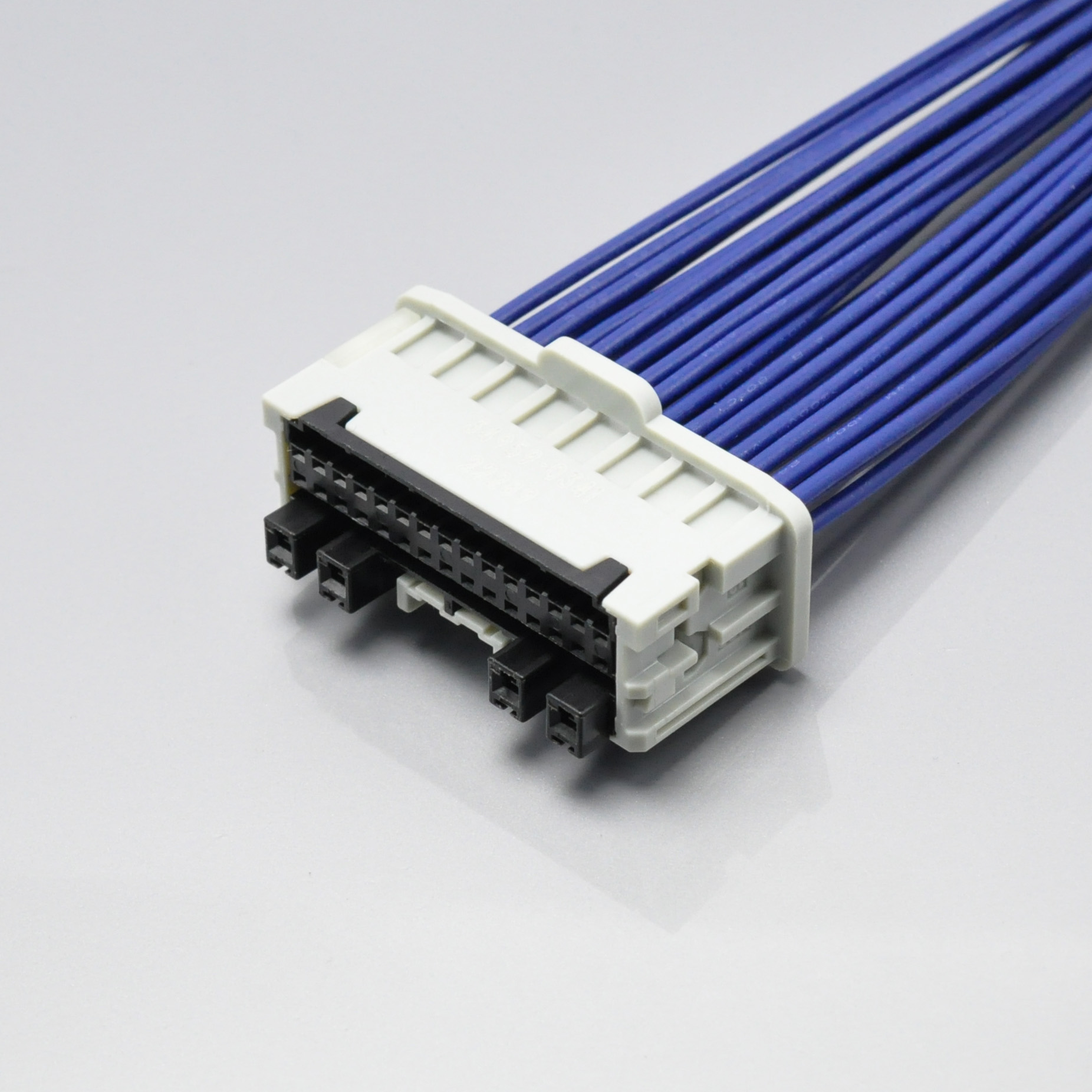
KONNRA KR2021 Mini50 housing, the cross-reference for the Molex 34959 three-row receptacle housing
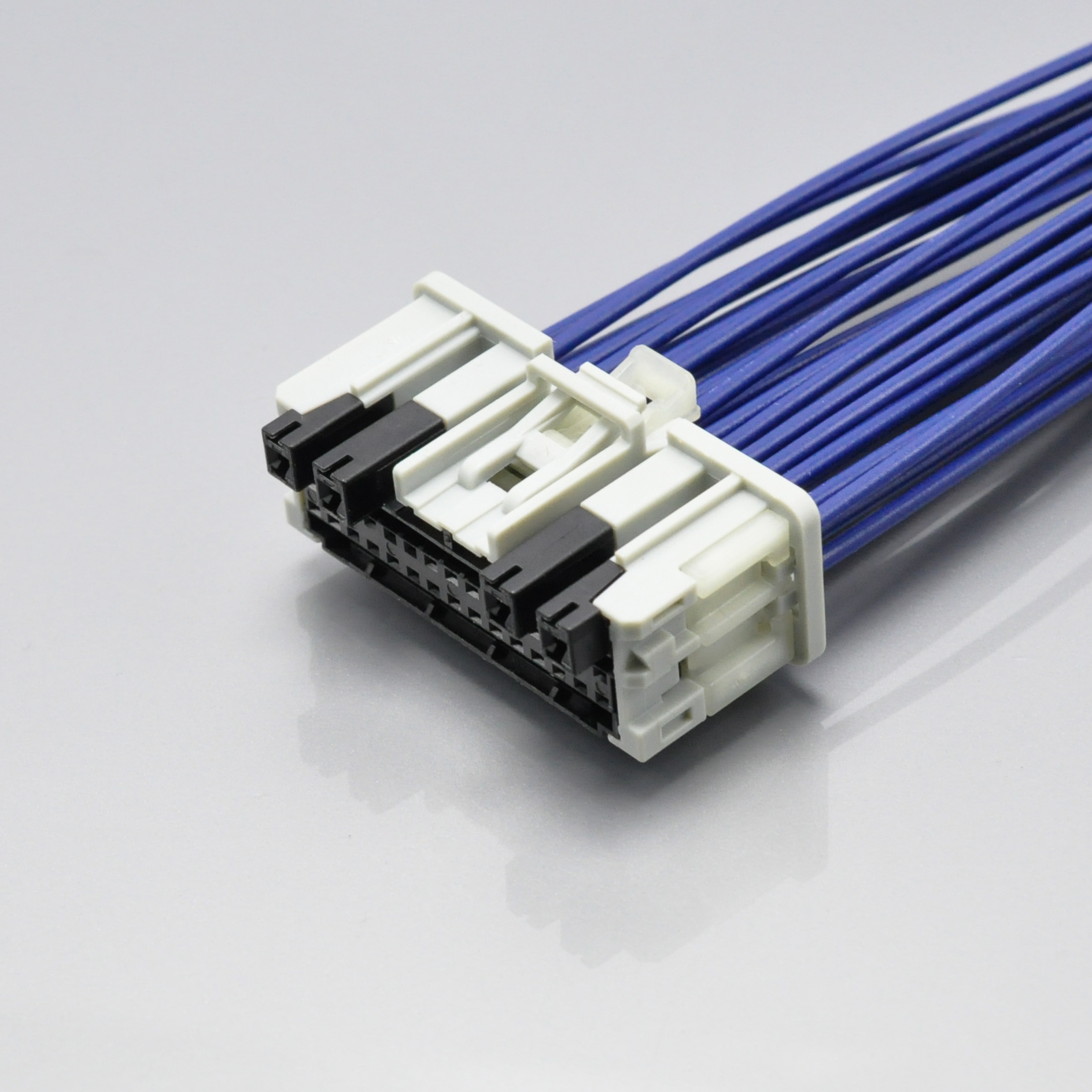
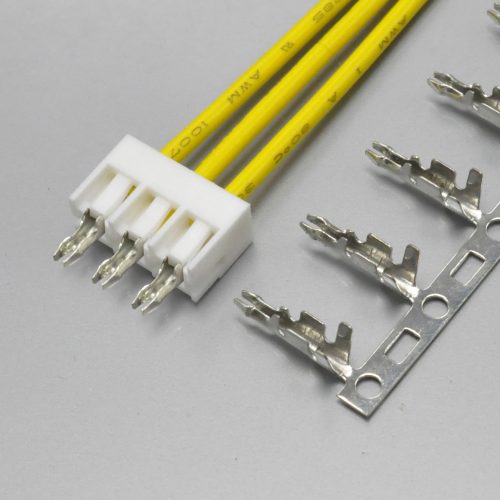
KONNRA KR2021 housing with CPA, showing the connector position assurance latch
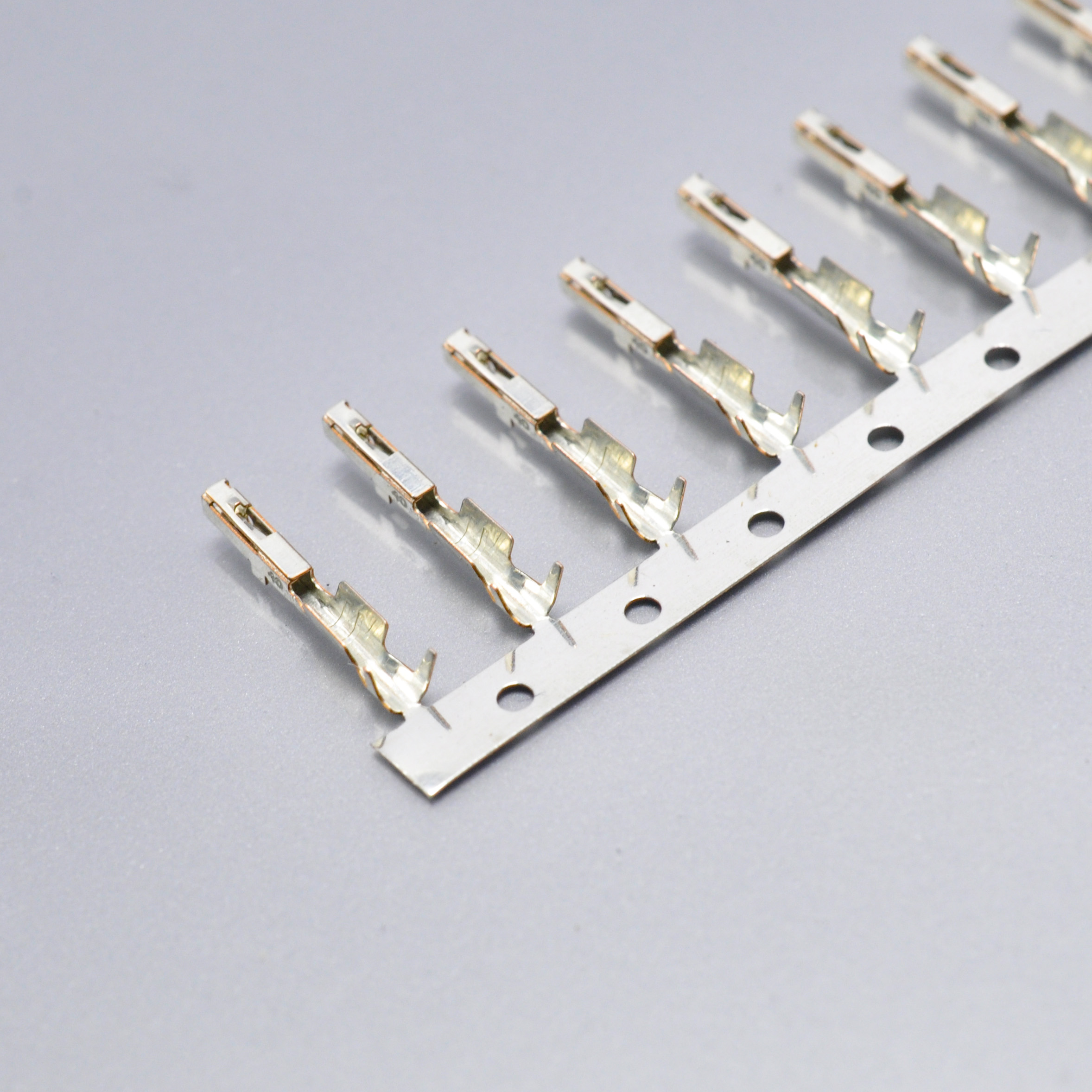
KONNRA KR2021 2.00mm terminal, the cross-reference for the Molex 560023 CTX50 terminal
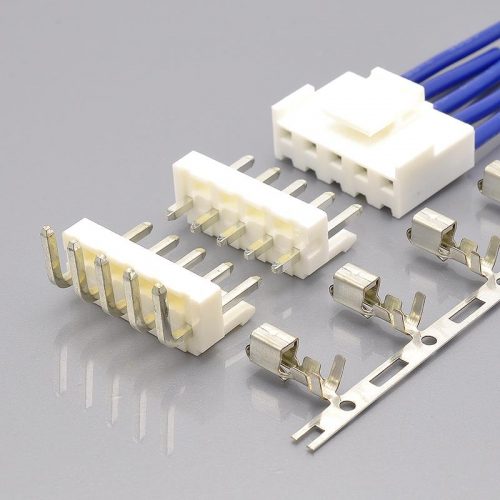
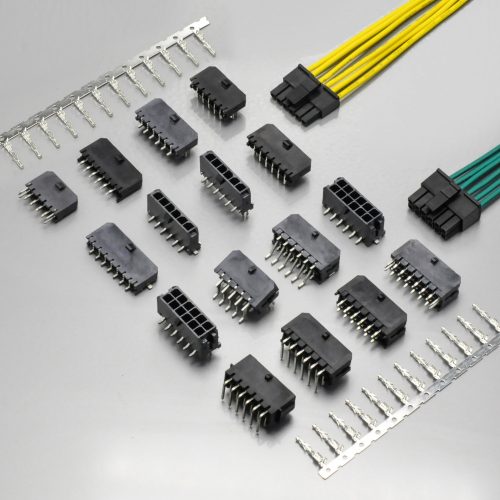
The two board-side configurations for the three-row system, shown here as KONNRA publishes them — note from the section above that no KONNRA part number is published for either:
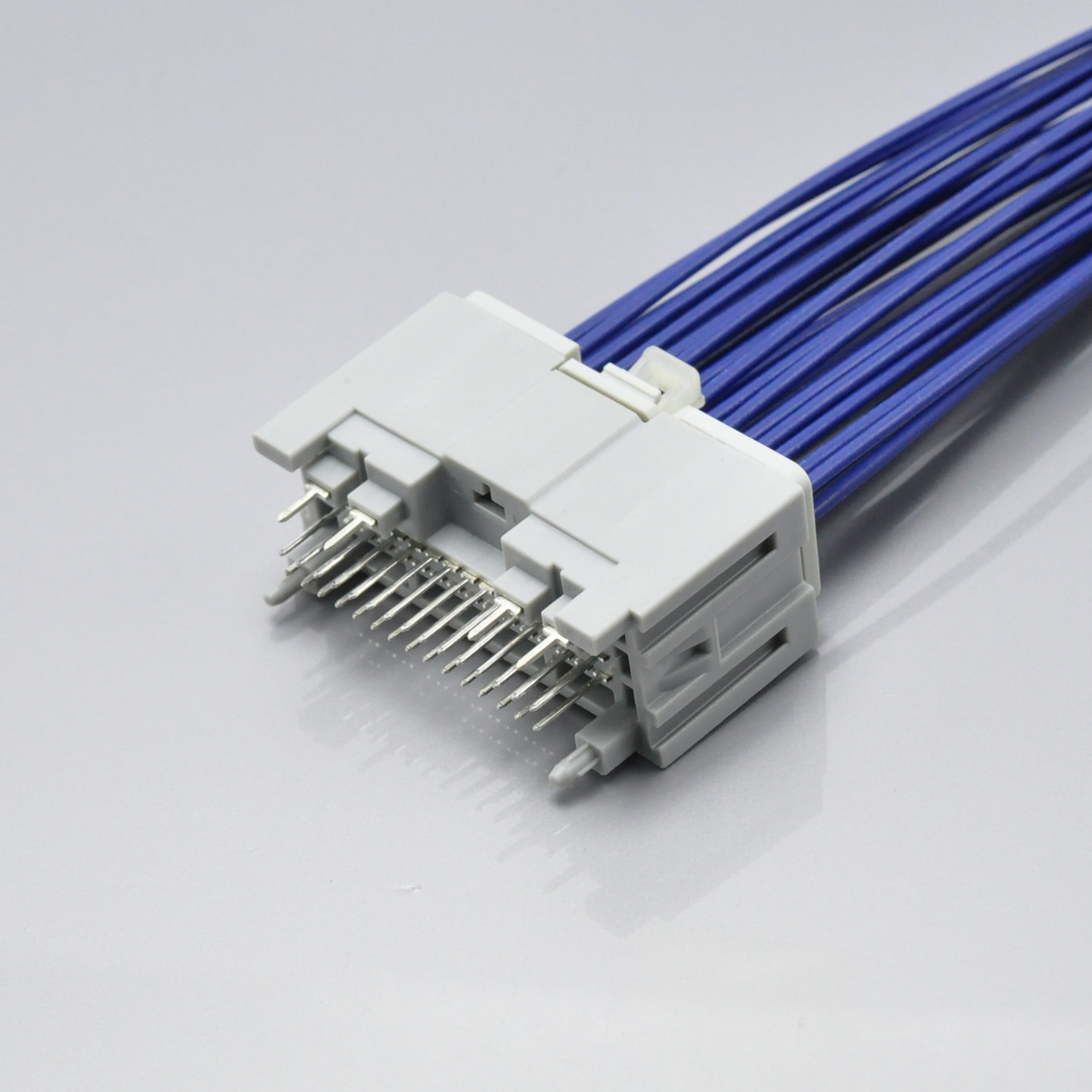
KONNRA KR2021 three-row DIP wafer, the board-side form for the Molex 34958 vertical header
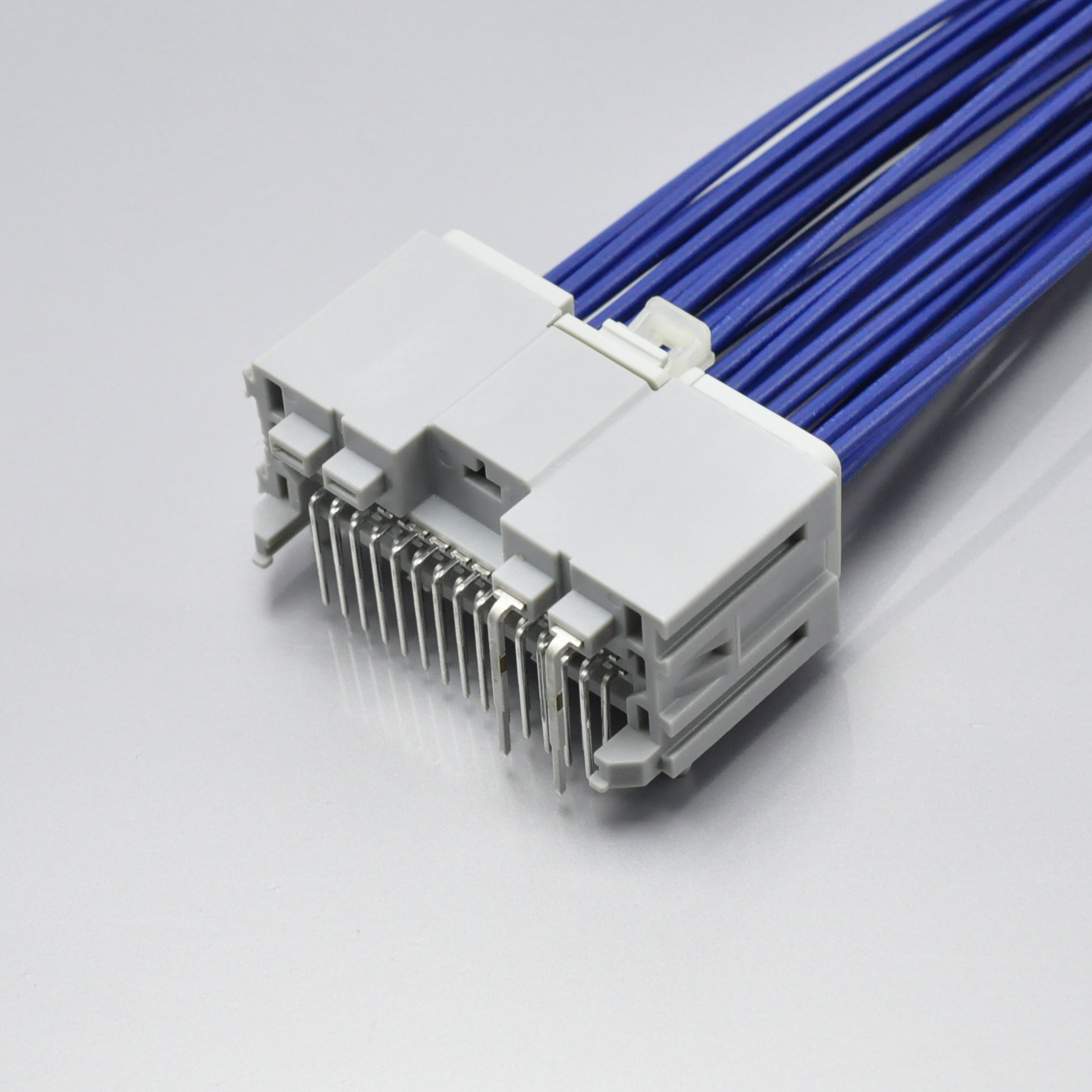
KONNRA KR2021 three-row right angle DIP wafer, the board-side form for the Molex 34961 right angle header
Where the KR2021 sits in the 2.00mm class
Within KONNRA’s automotive connectors category, this series sits with the supplier’s other vehicle-grade products rather than in the general 2.00mm pitch listing — which is appropriate, because the Mini50 is a USCAR-050 automotive interface and the qualification regime behind it (USCAR-2, GMW3191, SMES-152) is a different regime from a general-purpose 2.00mm connector.
The terminal cross-reference is clean and worth noting. The KR2021 terminal page names 560023 Series, which is Molex’s CTX50 terminal series — the actual terminal used in the Mini50 system. That is a correct and specific cross-reference at the terminal level.
Two parts of the cross-reference are not as clean.
- The terminal page pairs a part number with a drawing number. The cross-reference table lists KONNRA
T20210CT0101AagainstSD-560023-002.SD-is Molex’s prefix for a sales drawing, not a part number. So the table gives a drawing where the other series give a purchasable part number, and a customer cannot order from it directly. - The housing page names one family and lists another. As set out above, the “Compatible” field says 34959 while the cross-reference table lists 2133820340 / 341 / 342.
And one positioning point that matters for searching. KONNRA labels several 2.00mm series with Molex family names, and “Mini50” is the only one of them that is a USCAR-050 automotive interface. If you are looking for a general-purpose 2.00mm wire-to-board part, the Mini50 is the wrong system even though the pitch matches — its terminal is a 0.50mm system, its current rating is tied to a 14V operating limit, and its qualification regime is automotive. Match the family, not the pitch.
Cross-reference checklist: ten things to verify before you commit
Work through these in order. The first three decide whether the rest applies.
- Resolve the rated voltage before anything else. KONNRA’s specification says 14V AC/DC and Molex says 14 VDC maximum operating — and KONNRA’s product page and both component pages say 250V. Since Molex ties the 4.0A current rating to the 14V figure, selecting the part on a 250V basis would invalidate the current rating too. Get the rated voltage confirmed in writing.
- Decide sealed or unsealed, and check the part number family. Molex’s 34959 / 34958 / 34961 / 34960 are S1 Unsealed. The 2133820340 family that KONNRA’s housing page cross-references is sealed. KONNRA’s product page advertises IPX8, which belongs to the sealed product. Three statements, one part — establish which one you are buying.
- Confirm whether the board-side header is supplied. Section 2.0 lists the header housing and pins as
/, while section 3.0 specifies their materials and the product page shows four wafer images. If the header is not in scope, the cross-reference covers the harness side only. - Check that your hybrid needs are covered. A 34-way connector is 30 signal + 4 power; a 38-way is 30 + 8. Molex uses a 0.50mm CTX50 signal terminal and a 1.20mm power terminal. KONNRA publishes one terminal part number. If your design populates the power positions, that is unresolved.
- Compare the terminal retention requirement in the right direction. Molex’s un-locked figure is a maximum — 15N for the 0.50mm terminal — because the terminal must still be removable with the lock open. KONNRA states 20N minimum for the same state. A floor above a ceiling cannot both apply, and Molex’s own revision 2021 note records having corrected an inverted min/max on exactly these figures.
- Re-check any contact-resistance budget that was based on the web pages. The specification says 20mΩ max, matching Molex. The pages claim 15mΩ. Note also that the specification permits no increase after environmental conditioning — 20mΩ initial, 20mΩ after every one of its six environmental tests.
- Use the specification’s plating, not the page’s. The controlling document specifies tin or gold over nickel on both the terminal and the header contact; the product page says silver. “Silver” appears in Molex’s own part description as a colour option. If you need silver contacts, this series does not offer them; gold is the alternative both sides document.
- Settle the wire range and the crimp table. The crimp table covers 24 / 26 / 28 AWG; both component pages say 22–24 AWG; Molex’s grips are 0.13 / 0.22 / 0.35mm² (26 / 24 / 22 AWG). There is no published crimp setting for 22 AWG / 0.35mm², which is Molex’s heaviest grip. The crimp table is also numerically identical to the adjacent KR2014 series’ table despite a different terminal — worth verifying rather than assuming.
- Expect a higher insertion force than the original allows. KONNRA specifies up to 75N to mate and 100N to unmate without the latch; Molex’s USCAR-2 ceilings are 22N for both. These are maxima on both sides, so they do not conflict — but the permitted window is much wider on the replacement, and on a 34-circuit harness that is an assembly-ergonomics figure to measure.
- Verify the agency file against a certificate. KONNRA’s terminal page says E326732, its housing page says E482542, and Molex’s specification for this system records UL, CSA and TUV as “Not Applicable”. Two pages of one series cannot both be right about the file number, so ask which certificate covers the parts you are buying.
Frequently asked questions
What is the KONNRA KR2021 a replacement for?
The Molex Mini50 three-row 34/38-circuit system — the 2.00mm pitch member of the Mini50 family. The specific Molex references KONNRA names are the 34959 receptacle, the 34958 header and the 560023 CTX50 terminal. Note that the single-row and dual-row Mini50 receptacles (series 34791 and 34824) are built on a smaller pitch and are not this connector.
Is the KR2021 a replacement for a Molex MX34C?
No — MX34C is a JAE Electronics series, not a Molex one, and KONNRA publishes no JAE cross-reference at all. KONNRA’s own product page titles this series “KR2021 Equivalent To Molex MINI50“. If your design is on a JAE MX34C, this is a different cross-reference.
What is the rated voltage?
14V according to KONNRA’s specification section 4.0, and 14 VDC maximum operating according to Molex. KONNRA’s product page and both component pages say 250V, which is a factor of about eighteen higher and is not supported by either manufacturer’s specification. Molex ties the 4.0A current rating to that 14V figure.
Why does the page say 250V?
I cannot tell you from the documents — that is a question for the supplier. What the documents do show is that the page carries both a “Voltage: 250V” row and a separate “Withstanding Voltage: 1000V AC” row, while the specification carries a 14V rated voltage and a separate 1000V AC dielectric strength. The 1000V figures agree; it is the 14V that has been replaced by 250V on the pages. Whether that is a misreading of the withstanding figure or something else is not stated.
Is the contact resistance 15mΩ or 20mΩ?
20mΩ max per the specification, which is what Molex specifies as well. The product page and both component pages say 15mΩ max. The specification also requires 20mΩ after every one of its six environmental tests, so 20mΩ is both the initial and the post-conditioning limit.
Does the KR2021 include the board-side header?
The specification does not publish a header part number — both “MX Header Housings” and “PIN” are listed as / in section 2.0. However, section 3.0 specifies the header housing resin (SPS GF30%) and the pin material (BRASS) in detail, and the product page displays four wafer images. The most likely reading is that the header is available but the part number is not in this document, but confirm it in writing — it determines whether the cross-reference covers a complete mating pair.
Is it sealed? The page mentions IPX8.
The Molex system this series cross-references is unsealed — PS-34959-001 states “Sealing Classification: S1 (Unsealed)” in section 5.4, and the family datasheet is titled “Mini50 Unsealed Connector System”. KONNRA’s specification publishes no sealing classification at all, and its environmental programme contains no ingress test. The IPX8 claim on the page belongs to Molex’s sealed Mini50 range, a different product family.
Does it cover a hybrid 30+4P or 30+8P design?
Partly, and the power side is unresolved. The specification’s subject line names 30+4P and 30+8P, and the housing page lists 34P–38P in three rows, so the hybrid configuration is the intended application. But a 34-way hybrid needs thirty 0.50mm signal terminals and four 1.20mm power terminals, and the specification publishes one terminal part number. Molex sources the 1.20mm power terminal from TE (MCON 1.2mm), not from its own CTX50 range.
What wire does it take?
The crimp table covers 24, 26 and 28 AWG, with a stripping window of 1.6–2.3 mm and crimp strengths of 3.63, 2.27 and 1.36 kgf minimum. Both component pages instead say 22–24 AWG. Molex’s CTX50 grips are 0.13, 0.22 and 0.35mm² — approximately 26, 24 and 22 AWG. There is no published crimp setting for 0.35mm² / 22 AWG, which is Molex’s heaviest grip, and the crimp table’s 28 AWG row is lighter than anything the component pages or Molex list.
How many mating cycles does it take?
10 cycles, in both documents. KONNRA’s section 7.1 mates the connectors up to 10 cycles before the environmental tests; Molex’s USCAR-050 data gives 10 mating cycles for tin plating. For reference, the gold-plated option on the original is specified for over 10 cycles — so if you need more than 10, gold is the variant to ask about.
How does the retention compare with the original?
On the locked figures KONNRA is the more demanding — 55N minimum against Molex’s 30N (0.50mm terminal) and 40N (1.20mm terminal). On the un-locked figure the two documents are in opposite directions: Molex specifies a maximum of 15N (0.50mm) so the terminal stays removable, while KONNRA specifies a minimum of 20N. Note that Molex’s revision A3 in 2021 corrected inverted min/max values on these same four figures.
Is the insertion force comparable?
Both are specified as maximums, but the ceilings differ widely — KONNRA permits 75N to mate and 100N to unmate without the latch, against Molex’s USCAR-2 22N for both. Neither document contradicts the other, but the replacement is allowed to need substantially more insertion force, which is worth measuring on a first article for a 34-circuit harness.
What materials does it use?
The specification reproduces Molex’s callouts closely: harness housing PA66 GF35%, TPA and CPA PA66 GF50%, header housing SPS GF30%, terminal phosphor bronze, header contact BRASS. The Molex specification lists the same four resins and materials (PA66 GF35, PA66 GF50, SPS GF30, C26800 for pins and blades). This is the strongest part of the documentation.
Which agency is it listed to?
The terminal page lists UL/CUL E326732 and the housing page lists UL E482542 — two different file numbers for one series. Molex’s own specification for this system records UL, CSA and TUV file numbers as “Not Applicable”. Verify against a certificate rather than a web page.
What are the temperature and rise ratings?
−40 to +105°C operating on both sides, and a +55°C maximum rise over ambient on both. KONNRA’s rise figure is measured after 1008 hours of bench-top testing on a 45-minutes-on / 15-minutes-off cycle, which is a demanding basis and matches Molex’s 1008-hour exposure requirement.
Does it meet the same automotive test regime?
Largely, yes. KONNRA’s environmental programme mirrors Molex’s: 10 durability cycles, 300 thermal-shock cycles at −40°C to +105°C, 1008 hours at 105°C, a GMW3191 2012 humidity profile, 10 days at 85°C / 90% RH, and vibration at 2.13 Grms for 22 hours per axis with 25 G and 100 G shocks. Molex lists thermal shock as 300 and 600 cycles where KONNRA specifies 300 — so the replacement is qualified to the shorter duration.
Start your cross-reference check
Three facts decide most of this comparison, and all three come out of your own documentation.
- Send the Molex housing part number and the circuit count. A 34959 is the unsealed three-row receptacle; a 2133820340 is the sealed housing; a 34791 or 34824 is a smaller-pitch member of the same family and not this connector. That one number settles which product you are replacing before any rating is compared.
- Send your operating voltage and your terminal mix. The 14V rated voltage is what establishes the 4.0A current rating, so a higher-voltage application changes the current answer as well. And if your 34-way or 38-way hybrid populates the power positions, tell us — the cross-reference currently publishes a signal terminal only.
- Send your wire specification. The crimp table covers 24/26/28 AWG and Molex’s grips are 0.13/0.22/0.35mm². If you are on 0.35mm², there is no published KR2021 crimp setting and that has to be developed.
Then ask the questions the documents cannot answer: whether the board-side header is supplied, which sealing system the IPX8 claim belongs to, and what the rated voltage actually is.
The cross-referenced components that are published are the Housing (H20210***240*A, replacing the Molex 34959 three-row receptacle housing), the TPA / CPA (H202121342401A / H202131342401A, for the individual secondary lock and the connector position assurance latch) and the Terminal (T20210C***01A, replacing Molex’s 560023 CTX50 terminal). All are 2.00mm pitch, three rows, 34P–38P, rated 4A, −40°C to +105°C, with PA66 GF35/GF50 housings and SPS GF30 header resin.
- View the KONNRA KR2021 Mini50 wire-to-board connector series
- Download the KR2021 product specification (PS-KR2021-01)
- Download the KR2021 series drawing
- Send an enquiry to KONNRA
Sources and method
Every figure in this article comes from a manufacturer document and is cited so it can be checked. Where a figure could not be obtained, it is listed as not published rather than estimated.
Molex primary documents:
- Mini50 34/38CKT Connector System Product Specification,
PS-34959-001, Revision B, dated 2023/11/28, 13 sheets — Molex’s own specification for exactly the three-row 2.00mm system this article compares. Source of: the scope statement covering “the 2.00 mm centerline three row Mini50 0.50 & 1.20mm hybrid and non-hybrid unsealed wire to board connection system”; the product and series table (34959 receptacle, 34961 right-angle header, 34958 vertical header, 34960 two-bay and three-bay stacked headers); the materials table — PA66 GF35 harness housings, PA66 GF50 TPAs and CPAs, SPS GF30 header housings and alignment plate, C26800 pins and blades, tin with nickel under-plate; the terminal table including the CTX50 560023 part numbers and their obsolescence status and the TE MCON 1.2mm power terminals; the applicable documents table recording UL / CSA / TUV “Not Applicable”; section 5.1 “Maximum Operating Voltage: 14 VDC” with its footnote tying the figure to the current rating; section 5.2 isolation resistance 100MΩ min; section 5.3 the current table (4.0A for the CTX50 grips at 0.35, 0.22 and 0.13mm², with insulation diameters); section 5.4 classifications — T2 (−40 to +105°C), S1 (Unsealed), V1; section 5.5 creepage and clearance (0.4mm each) and the CTI material group; the revision summary recording the 2021 min/max corrections to the terminal retention figures and the CPA disengage force change to 10N min / 50N max; and section 10’s notes on GMW3191 class II and the 1.2mm terminal’s USCAR-2 V2 vibration limitation - Mini50 Unsealed Connector System datasheet (Molex, distributed by Mouser as
987650-5442). Source of: the USCAR-050 interface claim and the 4 to 24 circuit and 34 and 38 circuit ranges; the 500V / 4.0A / 20 milliohm / 1500V AC / 100 megohm reference table; the physical table (copper alloy contacts, tin contact area, nickel underplating, 0.13 to 0.35mm² (22 to 26 AWG), 0.89 to 1.40mm insulation, −40 to +105°C); the durability figures (10 mating cycles tin, over 10 gold); the high-temperature, humidity, thermal-shock, chemical and corrosion test results with their 20 milliohm / 100 megohm / 60N connector retention / 30N terminal retention limits; the temperature rise under 55°C requirement; the terminal and connector insertion-force figures (5N max insertion, 10N primary retention, 50N secondary retention); mating and unmating force 22N max; header pin retention 15N min; the SMES-152 solderability requirement; the ES-40000-5013 heat-resistance requirement (+260°C, 3 cycles); and the ordering tables for receptacles, CTX50 terminals and headers
KONNRA primary documents:
- Product specification PS-KR2021-01, Revision A1, dated 2023/6/19, 6 pages — subject “30+4P & 30+8P 2.00mm Pitch KR2021 Series Connector Specification“. Source of: the part-number table including the housing, the TPA/CPA numbers and the terminal, and the
/entries for header housing and pins; the materials table with the four resins and two contact materials and their platings; the crimp table; section 4.0 Rated Voltage 14V, 4A, −40 to +105°C; section 5.0 electrical performance including contact resistance 20 milliohms max, insulation resistance 100 Megohms min, temperature rise +55°C max and dielectric strength 1000V AC; section 6.0 with all seven mechanical items including the 20N / 55N terminal retention figures, the 75N / 100N / 80N insertion and withdrawal figures and the duplicated CPA extraction force rows; section 7.0 with all eight environmental items; section 9.0 both soldering profiles - Product page — source of the “250V” and “Withstanding Voltage: 1000V AC” table, the “15mΩ max” contact resistance, the “Product Plating: Silver” line, the IPX8 and “matte sealing design” claims, the engineering-drawing and specification download links, and the eight product images
- The two component pages: terminal and housing. Source of: the “250V” and “15mΩ Max” feature rows on both; the “Compatible” fields naming 560023 Series and 34959 Series respectively; the 22#–24# wire size on both; UL/CUL E326732 on the terminal page and UL E482542 on the housing page; the housing configuration 3 rows, 34P~38P, colour Gray, material PA66; and the part-number cross-reference tables pairing
T20210CT0101AwithSD-560023-002and the three housing part numbers with 2133820340, 2133820341 and 2133820342 - Automotive connectors category
Method notes:
The voltage finding rests on three independently published facts rather than on an inference: KONNRA’s specification states 14V, Molex’s specification states 14 VDC maximum operating, and three KONNRA web pages state 250V. The conclusion that the pages are the outliers follows from the specification agreeing with the original manufacturer.
The sealed/unsealed finding likewise rests on three published statements that cannot all describe one part — KONNRA’s “Compatible: 34959 Series”, KONNRA’s cross-reference to the sealed 2133820340 family, and the product page’s IPX8 claim — set against Molex’s explicit “Sealing Classification: S1 (Unsealed)” for the 34959 system.
The retention-direction finding compares Molex’s maximum for the un-locked state against KONNRA’s minimum for the same state. Molex’s revision A3 note documents that these four figures were previously stated with min and max the wrong way round and were corrected in 2021, which is why the direction is checked explicitly here rather than assumed.
The observation that the KR2021 crimp table is numerically identical to the KR2014 series’ table is a direct comparison of two published tables in this catalogue. It is presented as something to verify, not as a finding of error, because a shared terminal family would explain it.
The statement that the two-part-number UL listing cannot describe one product is an observation about internal consistency; the article does not assert which number is correct.
Disclosure: the MX34C note at the top of this article reflects what the public record shows — MX34C is a JAE Electronics series and KONNRA publishes no JAE cross-reference — while KONNRA’s own product page titles this series against Molex MINI50. If you were expecting a JAE comparison, this article does not provide one.
Corrections are welcome and will be made. If a figure here disagrees with the current revision of a manufacturer document, the manufacturer document is right and this article should be corrected against it.